Learning how to rank in Google Map Pack (the local 3-pack on Search, plus the ranked places list in Maps) means improving the three factors Google publicly emphasizes for local results — relevance, distance, and prominence — with a complete, verified Google Business Profile and a website that matches what people search. There is no paid “Map Pack boost” button; Google’s Help is explicit that you cannot request or pay for better local ranking.
This is the cross-vertical Map Pack checklist for single-location small businesses. It is not a plumber-only, HVAC-only, or auto-shop playbook — those vertical guides add trade-specific category and photo tactics on top of this foundation.
Hands-on help: local SEO, Google Business Profile.
How to rank in Google Map Pack: the SMB checklist
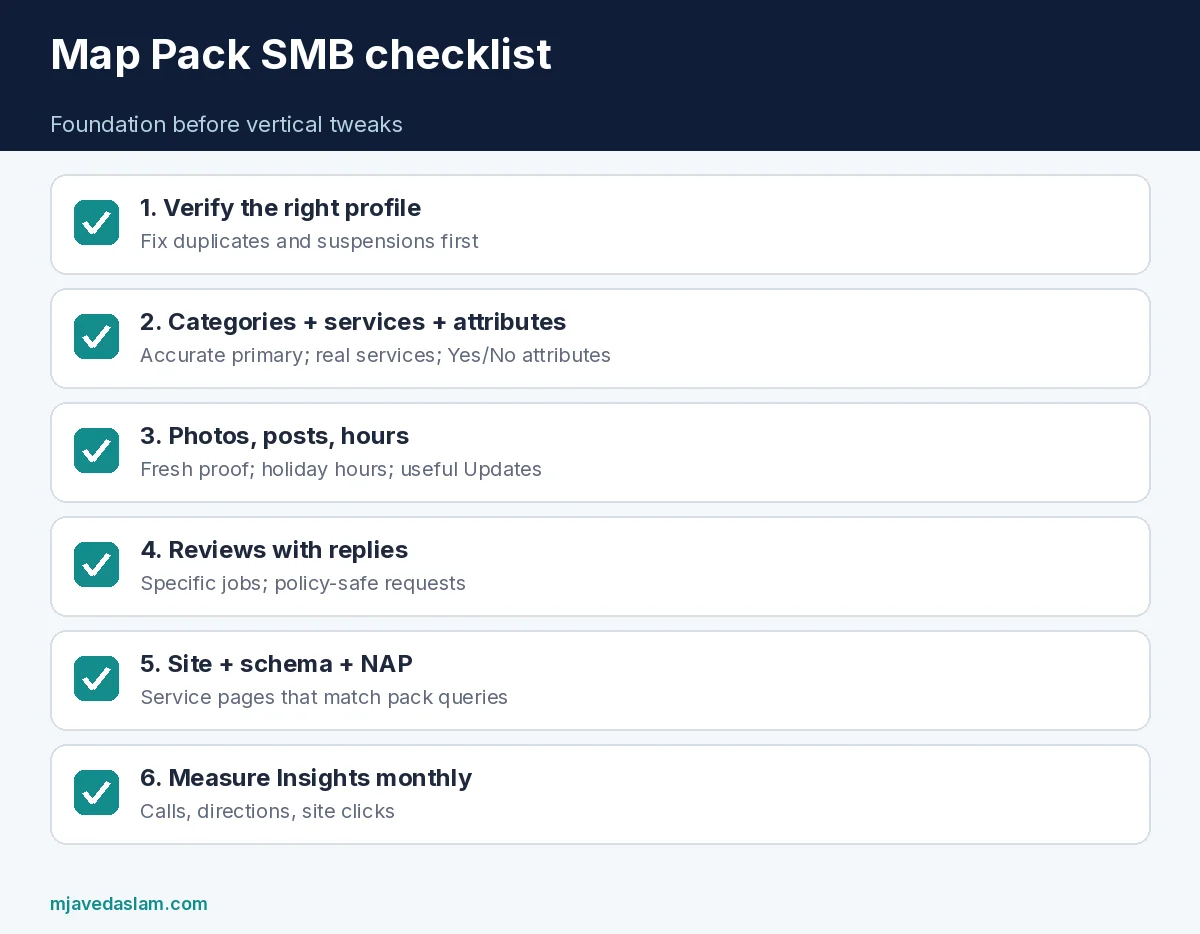
- Claim and verify the correct profile — duplicates and suspended listings block progress — claim GBP, fix duplicates.
- Put the pin on the real customer entrance (or follow service-area rules if you hide the address) — service-area businesses.
- Choose the most accurate primary category; add secondaries you truly offer.
- Complete hours (including holiday / special hours), phone, website, and a clear description.
- Fill attributes, services, and products that match reality — customers use them as filters.
- Upload policy-safe photos; post useful Updates / Offers / Events.
- Earn and reply to reviews with specifics — response templates.
- Build service pages that match Map Pack queries; keep NAP identical; add LocalBusiness schema.
- Measure calls, direction requests, and website clicks in Insights; improve weak landing pages before buying more ads.
- Stay patient: relevance + distance + prominence compound; spammy citations and fake reviews backfire.
Relevance, distance, prominence — in plain English
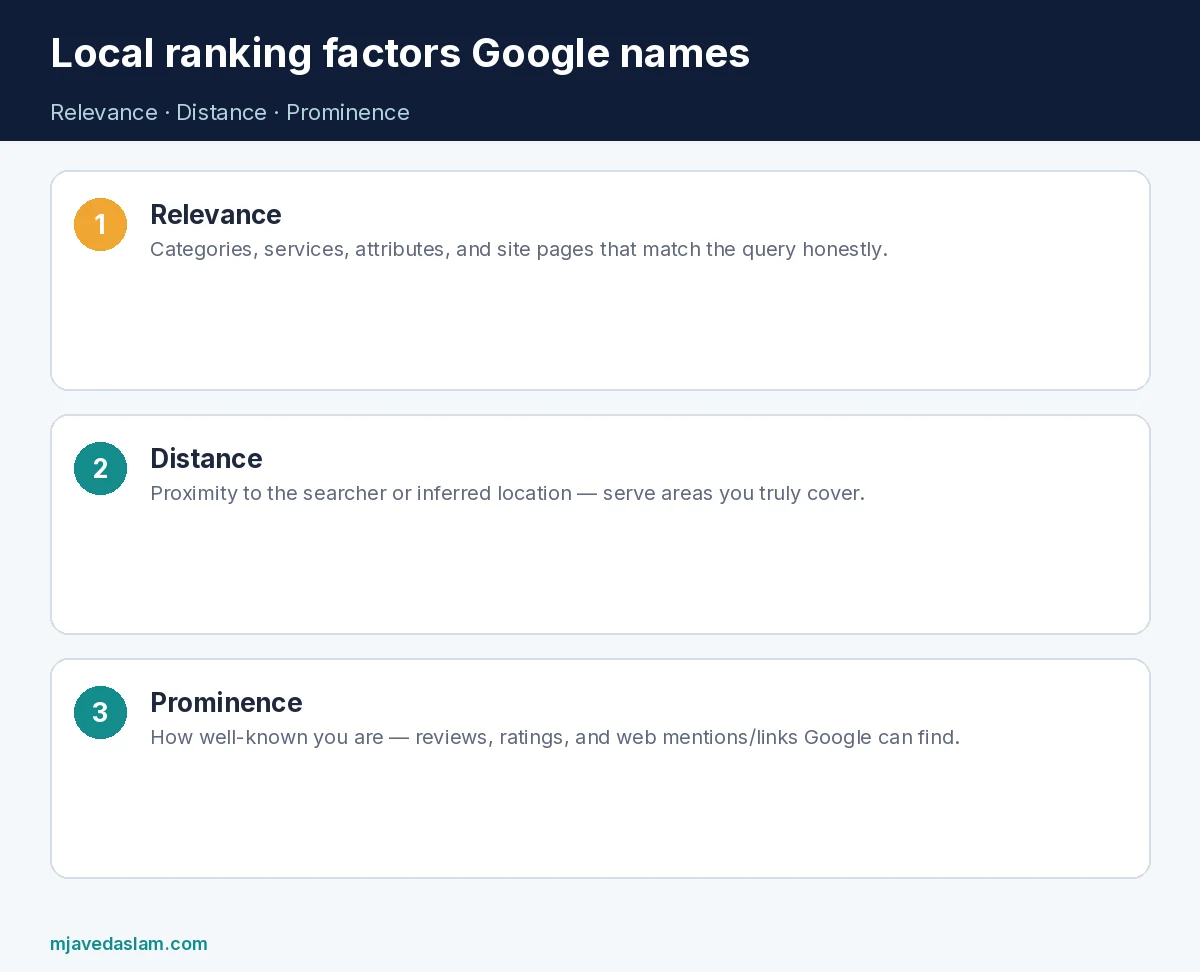
Google’s “Tips to improve your local ranking” Help states local results are mainly based on:
- Relevance — how well the profile matches the search. Complete categories, services, attributes, and on-site copy that use the words customers type (honestly).
- Distance — how far the business is from the searcher (or the location Google infers). You cannot “hack” geography; you can only serve areas you truly cover and set service areas accurately.
- Prominence — how well-known the business is, including signals such as reviews and information Google finds across the web (for example sites that mention or link to you).
Maps Help notes the same trio and that a farther business can still rank higher if it is a better match. Paid Maps pins are labeled ads — they are not organic Map Pack rank.
Profile completeness that supports Map Pack queries
- Categories & services: Primary = what you mainly are. Services list = jobs you want to be found for. Do not stuff unrelated categories.
- Attributes: Accessibility, payments, amenities — fill every accurate Yes/No. Attribute searches can surface businesses that opted in — see the attributes guide in this cluster when published; edit via Edit profile → More in Google’s attributes Help.
- Photos & video: Exterior, interior, team-at-work (no stolen stock), project proof. Fresh photos signal an active business.
- Q&A and messaging: Answer owner Q&A; enable Chat only if you reply — messaging.
- Booking / links: If eligible, add a real appointment URL — booking link.
- Products: Retail and eligible categories can showcase products; keep inventory honest.
Website and off-site signals that reinforce prominence
- One clear NAP in footer and contact page matching GBP character-for-character where possible.
- Separate pages for each money service + city pages only if you genuinely operate there (no doorway spam).
- LocalBusiness / Organization schema that mirrors visible facts.
- Earn mentions from local newspapers, chambers, suppliers, and partners — links help prominence; directories should stay consistent, not hundreds of thin spam listings.
- Technical basics: indexable pages, working links — broken links, Core Web Vitals, sensible XML sitemap.
Reviews without the folklore
Google lists reviews among prominence-related signals and encourages responding. Velocity from real customers beats bought stars. Ask for specifics (“kitchen remodel on Oak St,” “same-day AC recharge”). Reply to negatives with facts and a path to resolve offline. Review gating that only funnels happy people to Google violates Google’s review policies — do not build a process around that.
A 14-day Map Pack sprint (single location)
- Day 1–2: Verify ownership; merge/report duplicates; confirm pin and phone.
- Day 3–4: Categories, services, attributes, hours, description rewrite.
- Day 5–6: Photo shoot — 15+ unique images; upload in batches.
- Day 7–8: Publish or improve two service pages that match top Map queries.
- Day 9–10: Schema + NAP audit on site and top citations.
- Day 11–12: Review request process for last 20 happy customers.
- Day 13–14: First GBP Post; set a monthly Insights review reminder.
Re-check rankings with the same device location story each time (or a trusted rank tool with a fixed geo). Map Pack is personalized and proximity-sensitive — screenshot theater without a fixed method wastes time.
Ads can cover gaps while organic catches up — prefer Search for high-intent terms — Search vs Display — but do not expect ads to “buy” organic pack rank.
When you study how to rank in Google Map Pack competitors, look at their categories, photo freshness, review specificity, and whether their site has a page that matches the query — not at secret “citation scores.” Copy what is accurate and ethical; ignore spam patterns that will not last.
Multi-location brands should optimize each location’s profile and landing page separately. Sharing one phone tree and one stock photo pack across cities usually shows.
What “ranking” looks like week to week
Map Pack positions move with the searcher’s location, the exact query, personalization, and how Google blends ads with organic local results. When you test how to rank in Google Map Pack phrases like “dentist near me” versus “Invisalign [neighborhood],” you may see different competitors. Track a fixed set of 5–10 money queries from the same geo method every two weeks. Record: pack presence (yes/no), approximate position, GBP rating/review count, and whether your photo or hours look wrong in the live panel.
If you appear for brand queries but not category queries, relevance and category/services usually need work. If you appear two kilometers away but vanish at the city center grid, distance and denser competitors dominate — improve prominence and on-page proof rather than inventing a fake downtown address.
Seasonal businesses (tax prep, HVAC peak summer, holiday lighting) should update Special hours and posts before the rush, then ask for reviews during the busy window when satisfaction is highest. Quiet months are for photo refreshes and service-page rewrites — not panic-buying random citation blasts.
Finally, align the team: the front desk must know the public hours and services listed on Google. Nothing burns Map Pack trust faster than winning the click and disappointing the caller with “we don’t do that anymore.”
FAQ: how to rank in Google Map Pack
How long does it take to rank in the Map Pack?
It varies by city competition and how incomplete the profile was. Some fixes (hours, categories, photos) show sooner; prominence from reviews and web mentions compounds over months. No honest guide can promise page-one in 7 days.
Does verifying guarantee Map Pack placement?
No. Google’s business-info Help notes verification does not guarantee appearance in search. It is necessary groundwork, not a ranking coupon.
Can I pay Google for a higher organic Map Pack spot?
No. Local ranking Help states you cannot request or pay for better local ranking. Labeled Map ads are separate.
Do keywords in my business name help?
Stuffing services into the name against guidelines risks suspension. Use the real business name; put keywords in categories, services, description, and site pages.
Is the Map Pack the same on mobile and desktop?
Layouts differ, and proximity matters a lot on mobile. Treat mobile Maps/Search as the primary experience for local services.
Should service-area businesses expect the same pack behavior?
SABs follow address-display rules and still compete on relevance and prominence within served areas. Mis-hiding or faking an address is a fast way to lose trust — follow SAB guidance.