
Here’s the short answer. Local SEO for pest control means getting your company into the Google map pack and local results when someone nearby searches “pest control near me”, “termite inspection” or “mice in the attic”. In practice it comes down to five jobs: a verified Google Business Profile with the right category and real service areas, one strong website page per pest and per main town, steady genuine reviews, seasonal content that goes live before each pest season starts, and fast answers when the phone rings. Google says local results are mainly based on relevance, distance and prominence. Each of these jobs feeds one of those three.
I run local SEO and Google Business Profile work for small service businesses, and pest control is one of the trades where the gap between a tidy profile and a neglected one shows up quickly in the calls. This guide is the checklist I use. It follows the same pattern as my guides for HVAC companies and roofers, but the details are specific to exterminators: emergency intent, safety questions, recurring plans and strong seasons.
Why local SEO for pest control is different
Most pest searches are urgent and local. A homeowner who finds wasps by the back door or droppings in the kitchen does not want to read ten blogs. They want a nearby company that looks trustworthy and can come soon, which is why your Google Business Profile often matters more than your homepage.
Three things make the trade different from other home services:
- Demand moves with the seasons. Which pests people search for changes through the year and differs by region. If your pages and posts go live after the season has started, you are late.
- Trust and safety questions are part of the sale. People ask about children, pets, chemicals and licensing before they book. Pages that answer those questions plainly convert better than pages that only list services.
- Many companies are service-area businesses. Technicians visit the customer. That changes how you set up the address and service areas on Google.
How Google ranks local pest control companies
Google’s own local ranking tips say local results are mainly based on relevance, distance and prominence. Google also says there is no way to request or pay for a better local ranking. That is useful because it tells you where to spend effort:
- Relevance is how well your profile matches the search. Complete details, the right category and a clear list of services help here.
- Distance is how far you are from the searcher. You cannot change it, so do not try to fake it with extra addresses.
- Prominence is how well known you are. Google names links to your business and the number of reviews and positive ratings as part of it.
Set up your Google Business Profile for pest control
If your profile is not verified yet, do that first. Then work through the fields in this order, the same list my Google Business Profile service follows.
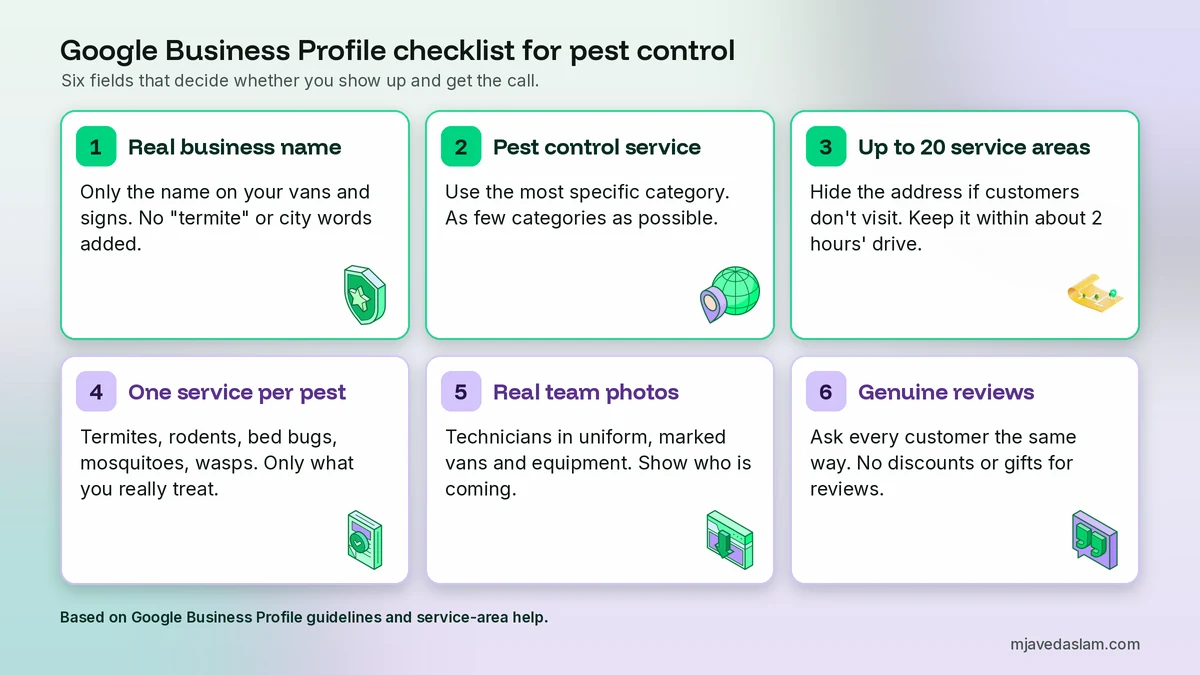
Business name: the real name only
Google’s guidelines for representing your business say the name must match the real-world name used on your signage, vans, website and stationery. Adding service words such as “Termite and Rodent Experts” or a city name to the profile name is not allowed and can lead to suspension. My Business Profile name guidelines post covers the edge cases.
Primary category
Pick the most specific pest control category Google offers in your country. For most companies that is Pest control service. Google’s guidelines ask you to use as few categories as possible and to choose ones that complete the sentence “this business IS a”. Do not add categories just as keywords. If you also run a real, separate line of work, a secondary category can make sense. I explain how to choose in my guide to the Google Business Profile primary category.
Address and service areas
If customers do not visit your office, you are a service-area business. Google says you should remove the address from the profile and set service areas instead. You can add up to 20 service areas by city, postal code or other area, and Google’s service area help says the overall area should not be more than about two hours of driving from where your business is based. List the towns you actually serve, not every town in the state. The details are in my service-area business guide.
Do not create extra profiles at virtual offices or empty addresses to cover more towns. Google allows one profile per real location with its own staff.
Services, hours and description
- Services: add each main service as its own line: termite inspection, termite treatment, rodent control, bed bug treatment, mosquito control, wasp and hornet removal, and so on. Only list what you really do.
- Hours: show your real phone hours. If you offer same-day or out-of-hours call-outs, say so in the description and on the website, but only if it is true.
- Description: plain English about what you treat, the area you cover, how long you have been in business and how you handle safety for families and pets. No links, prices or sale offers. The guidelines do not allow them in the description.
Photos that build trust
Pest control buyers want to see who is coming to the house. Upload real photos of your technicians in uniform, your marked vehicles, your team and your equipment. My Business Profile photo guidelines explain sizes and what Google rejects.
Build website pages for each pest and each main town
Your Business Profile tells Google what you are. Your website tells Google, and the customer, what you do in detail. For pest control I build three kinds of page:
- One page per pest or service. Termites, rodents, bed bugs, mosquitoes, ants, wasps, cockroaches. Each page explains the signs, how you treat it, what the customer must do to prepare, how many visits it usually takes and whether there is a guarantee.
- One page per main town, only when you have something real to say. Name the neighbourhoods you cover, local jobs you have done and the team that serves that area. A copied page with only the town name swapped is thin content, and it rarely ranks.
- A safety and licensing page. Explain how you treat around children and pets, what products you use in general terms, and show your licence details if your state or country issues them. This page answers the questions people ask before they call.
On every page put the phone number high up and make it tap-to-call on mobile. Keep the business name, address (if shown) and phone number the same as on the profile. Adding LocalBusiness schema in WordPress helps Google connect the site to the business, but it does not replace good page content.
Set your profile’s website link to the most relevant page, usually the homepage or a main pest control services page. If you want to see how many visits actually come from the profile, add UTM parameters to the Business Profile link so GA4 shows them as their own source.
Reviews: steady, genuine and answered
For pest control, reviews do two jobs. They help prominence, which Google names directly, and they answer the buyer’s real worry: will this company turn up, solve the problem and treat my home with care?
Google’s tips to get more reviews say you can remind customers to leave a review with a link or QR code, and that you should reply to reviews. The same page is clear that offering free or discounted services in exchange for a review is strictly prohibited. Google’s Maps content policy also bans review gating, meaning you cannot ask only happy customers or discourage negative reviews.
Here is the routine I recommend:
- Ask every customer the same way after the job is finished and the result is checked, not only the ones you think are happy.
- Use a short link or a Google review QR code on the invoice, the follow-up text and the technician’s tablet.
- Reply to every review. For negative reviews, stay calm, acknowledge the problem, and take the details offline. Never share private information about the customer.
Seasonal keywords: publish before the season starts
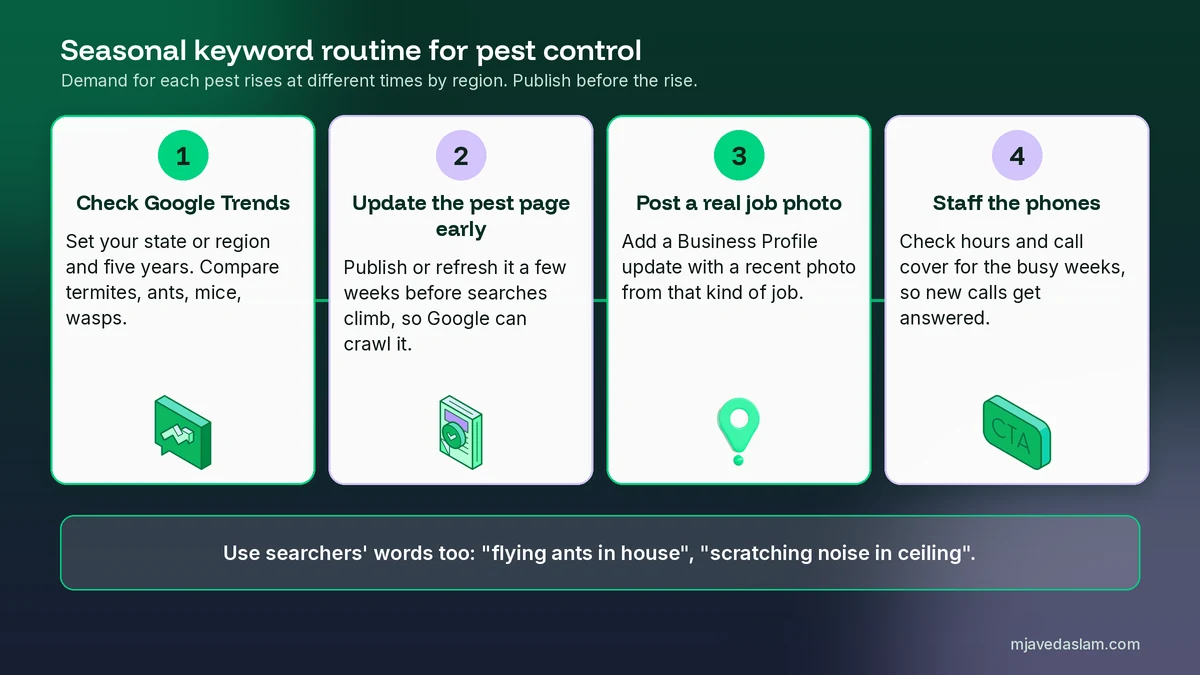
This is the part most pest control websites miss. Search demand for each pest rises and falls through the year, and the pattern changes from one region to another. Instead of guessing, open Google Trends, set it to your state or region and the last five years, and compare terms such as termites, mosquitoes, ants, wasps, mice and bed bugs. You will see when each one starts climbing in your area.
Then plan backwards:
- Update or publish the pest page a few weeks before its rise, so Google has time to crawl it.
- Post a short Google Business Profile update with a real photo from a recent job in that category.
- Add a seasonal question-and-answer section to the page: signs to look for, what the customer can do today, and when to call.
- Check your hours and phone cover for the busy weeks, so new calls are actually answered.
Use the searcher’s own words. People often search what they see, not the pest name: “small black ants in kitchen”, “scratching noise in the ceiling”, “flying ants in house”. Put those phrases in headings and answers on the relevant pages where they fit naturally.
Emergency intent: win the urgent call
A lot of pest searches are urgent: a wasp nest by the front door, a rat in the kitchen, bed bugs found in a bedroom. The searcher picks quickly. A few practical points decide who gets that call:
- The Call button on your profile connects to a phone that is answered, or that has a voicemail promising a callback time you keep.
- Your hours on the profile match reality. If you say open, someone answers.
- Your website says clearly if you offer same-day visits, and the page loads fast on a phone.
Track it. Google’s Business Profile performance report shows calls, website clicks and direction requests. My guide to Google Business Profile insights explains which numbers to watch each month.
Spam competitors and fake listings
Pest control is one of the trades where I regularly see map pack listings with keyword-stuffed names or addresses that turn out to be empty. If a competitor breaks the rules, do not copy them. Report it properly. My guide on how to report a fake Google Business Profile walks through the redressal form and what evidence to collect.
Paid options alongside local SEO
Local SEO takes time. If you need calls this month, paid options can fill the gap while the profile and pages mature. Google’s service area help points service-area businesses to Local Services Ads, and Google Ads search campaigns are the other option. I compare the two in Local Services Ads vs Google Ads. Fix the profile and main pages first, because both send people there.
A 30-day local SEO plan for a pest control company
- Week 1: verify the profile, fix the name, set the primary category, remove the address if you are a service-area business, and set accurate service areas and hours.
- Week 2: add every real service, write a plain description, upload 10 to 20 real photos of staff, vans and equipment, and set the website link with UTM tags.
- Week 3: publish or improve the pages for your top three pests and the safety and licensing page. Add tap-to-call and LocalBusiness schema.
- Week 4: start the review routine with every completed job, reply to all existing reviews, check Google Trends for the next season and schedule the matching page update and profile post.
After that, review the profile performance each month and keep the seasonal routine going. For the wider strategy, including citations and links, see my local SEO service. If you run another trade as well, the guide to local SEO for electricians shows how the same checklist works for emergency and planned work. My guide to local SEO for locksmiths covers another emergency trade.
FAQ: local SEO for pest control
What is local SEO for pest control?
It is the work that helps a pest control company appear in the Google map pack and local results when nearby people search for help. It covers your Google Business Profile, pest and town pages on your website, genuine reviews, seasonal content and how fast you answer calls. Google says local results are mainly based on relevance, distance and prominence.
Which Google Business Profile category should a pest control company use?
Use the most specific pest control category Google offers in your country, which for most companies is Pest control service. Google asks businesses to use as few categories as possible and not to add categories just as keywords. Add a secondary category only if you really run that separate line of work.
Should a pest control company show its address on Google?
Only if customers visit you there and the location is staffed with permanent signage. If your technicians go to the customer, Google says you are a service-area business, so remove the address and set up to 20 service areas instead. The overall area should not be more than about two hours of driving from your base.
Can I add keywords like termite or rodent to my business name on Google?
No, not unless they are part of your real-world business name on your signage, vans and paperwork. Google’s guidelines do not allow extra service or location words in the profile name, and it can lead to suspension. Put services in the services list, the description and your website pages instead.
How do pest control companies get more Google reviews?
Ask every customer the same way after the job is finished, using a short review link or QR code on the invoice or follow-up text, and reply to every review. Google prohibits offering discounts or free services for reviews, and it does not allow asking only happy customers.
How do seasonal pests affect local SEO?
Search demand for each pest rises and falls through the year and differs by region. Check Google Trends for your area, then update the matching website page and post on your Business Profile a few weeks before each rise, so Google has crawled the content by the time people start searching.
Next step
Start with the profile this week: real name, the right category, accurate service areas and real photos. Then pick the pest whose season comes next in your area and make that page the best answer in your town before the searches rise. If you want me to look at your profile, pages and reviews together, see my Google Business Profile service or my wider local SEO work.