Storm season floods Maps with “roof leak near me” and insurance-driven searches — and half the profiles that show up still say “open” with a stock skyline photo. This is a practical local seo for roofers playbook: Google Business Profile setup, storm-season content, reviews, and site pages that win the Map Pack without fake categories or bought reviews.
Same local ranking ingredients Google publishes for everyone — relevance, distance, prominence — applied to roofing. Distinct from plumber/HVAC/dentist verticals: emergency weather spikes, before/after proof, and service-area reality dominate.
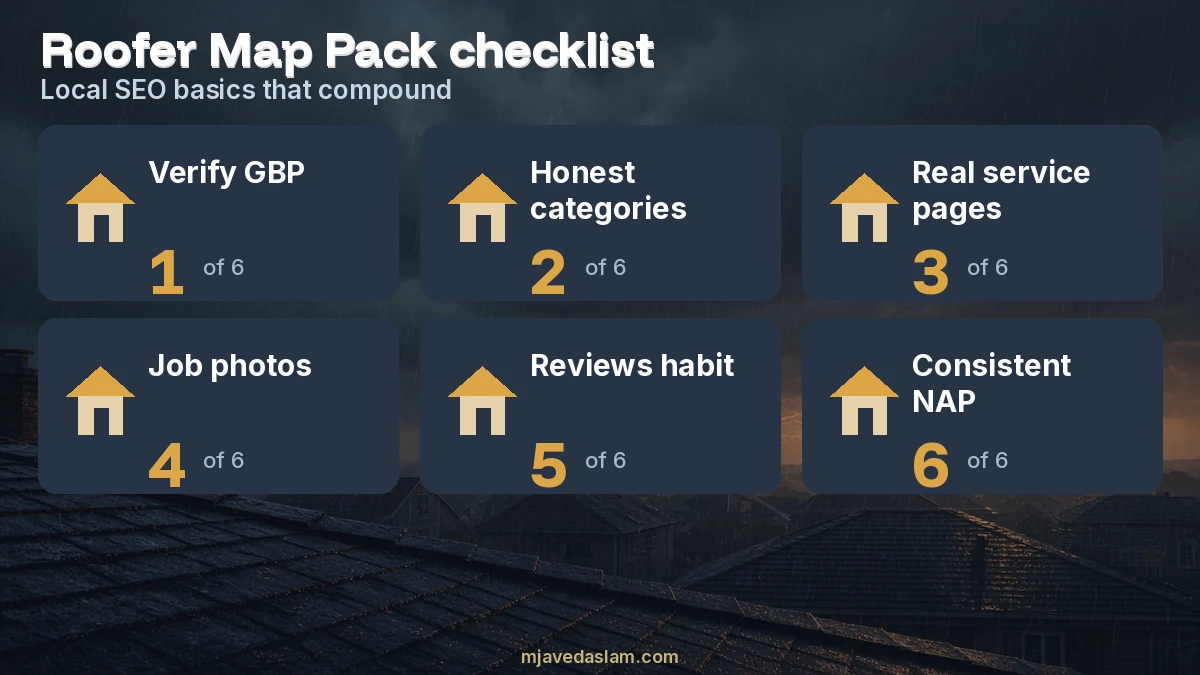
Local SEO for roofers: Map Pack checklist
- Claim and verify every eligible location (or run a clean service-area profile if you hide the address).
- Pick an accurate primary category (often Roofer / Roofing contractor — use Google’s list, not wishful SEO stuffing).
- Fill services customers search (repair, replacement, inspection, storm damage) with honest descriptions.
- Publish city + service pages that match real coverage — no doorway spam for towns you never visit.
- Photo set: exteriors, crew at work, materials, completed roofs (policy-safe; real jobs).
- Review engine: ask for genuine reviews; reply fast after storm surges.
- Keep NAP identical on site, profile, and citations you control.
Google Business Profile setup for roofing companies
- Primary category: Most specific accurate option (commonly Roofing contractor / Roofer). Add secondaries only for services you truly offer (e.g., gutter services) — not every home-service category under the sun. See primary category guide.
- Service area: If you don’t serve walk-ins at a storefront, follow SAB rules — service-area Business Profile. Don’t invent a fake office for ranking.
- Services: List repair, replacement, inspection, flat vs steep, material types you actually install. Prices optional; clarity helps.
- Description: Within Google’s limits — no keyword stuffing or URLs in the wrong fields — description guide.
- Photos/video: Follow size and reality rules — photos guidelines. Storm-damage jobs need consent and no private homeowner data in frames.
Storm-season Map Pack playbook
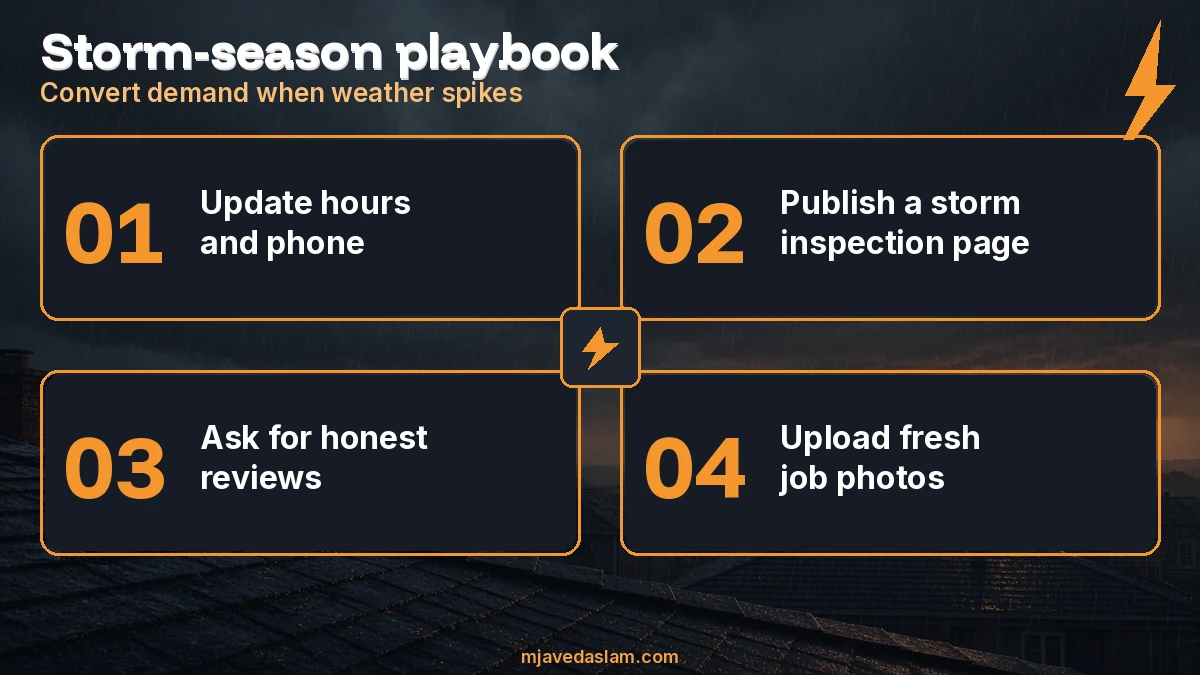
When hail or wind hits, demand spikes. Ranking doesn’t flip overnight from one blog post — but prepared roofers convert the attention they already earn:
- Hours & phone: Update special hours if crews are booked solid; missed calls during storms are lost jobs.
- Google posts / updates: Short, factual storm-response notes beat hype. No fake “FEMA approved” claims.
- Landing page: One clear “storm damage roof inspection” page with process, service area, insurance documentation tips (general info, not legal advice), and a form/call CTA.
- Reviews: After completed storm jobs, ask for honest reviews with a link/QR — never incentives to post/change/remove — see review response templates.
- Photos: Upload fresh completed-work photos (with permission) so the profile doesn’t look abandoned mid-season.
Website pages that support local relevance
- Homepage: who you are, cities served, license/insurance badges you can prove, primary CTA.
- Service pages: repair, replacement, inspection — unique copy, not spun city clones.
- City pages only where you truly operate and can fulfill work.
- Project gallery with real addresses omitted or generalized for privacy.
- LocalBusiness schema aligned with real NAP — LocalBusiness schema.
- Fast mobile pages — storm searchers are on phones; fix Core Web Vitals.
Avoid doorway networks of thin “roofing in [every suburb]” pages. Google’s local systems reward relevance and prominence; spam city pages burn trust.
Prominence: reviews, links, and brand searches
Prominence includes how well-known your business is. Practically for roofers:
- Steady genuine Google reviews with thoughtful replies.
- Consistent citations (directories you already use) matching NAP.
- Local brand mentions from real jobs, sponsorships, or news — not PBNs.
- A website people actually search your company name for after seeing the truck wrap.
Duplicates kill prominence clarity — fix duplicate profiles before pouring budget into Ads.
Paid search during storms (optional)
Organic Map Pack won’t cover every spike. If you run Google Ads, tighten match types and negatives for DIY / jobs / wholesale queries — match types explained, negatives. Landing pages must match the ad promise (inspection vs full replacement).
Crew safety and licensing claims on the site should match reality. “Fully licensed & insured” without proof invites skepticism; link to license lookup pages where your state publishes them. Insurance adjusters and skeptical homeowners both Google you — inconsistency between Ads, GBP, and the website is a conversion killer even when you rank.
Material education pages (asphalt shingle vs metal vs flat) can earn organic traffic, but keep a conversion path to inspection booking. Pure encyclopedia content without local proof won’t beat a competitor with fifty recent five-star reviews and clear photos of local jobs.
Multi-crew companies: train whoever answers the storm-line phone to log lead source (Google, referral, yard sign). Local SEO wins mean nothing if the CRM never attributes Map Pack calls. Call tracking numbers on the website are fine; keep the GBP primary number stable unless you understand how forwarding affects the profile.
Off-season is when you fix categories, rebuild photo sets, and publish the inspection page — not the morning after hail. Treat storm season as conversion mode; treat winter/shoulder months as foundation mode.
Compare yourself to Map Pack competitors monthly: categories, photo count/quality, review velocity, and whether they list the same cities. Copying their keyword-stuffed description is not the fix — beating them on verified accuracy, faster replies, and clearer service pages is.
Gutter, siding, and solar add-ons belong in secondary categories and separate service pages only when those crews and licenses are real. Inflating the profile into a full exterior remodel brand you don’t operate invites bad matches and policy risk.
For franchise or multi-location roofing brands, each eligible location needs its own profile and the same primary category across locations per Google’s rules. Don’t merge cities into one mega-profile to “concentrate reviews.”
Schema and FAQ blocks help clarify services for search engines and users, but they don’t replace Business Profile completeness. Keep FAQ answers short and accurate — especially around insurance timelines, which vary by carrier and shouldn’t be overpromised.
Finally, track organic calls and direction requests alongside form fills. Roofing leads often call from Maps; if you only watch website sessions, you’ll undervalue local SEO wins during storm weeks.
Internal linking helps too: from the storm page to repair and replacement pages, from city pages back to the main services hub, and from the blog only when a post adds first-hand local insight. Orphan storm posts that never link to booking waste the traffic spike.
If you rebrand after a merger, update GBP name carefully under Google’s representation guidelines and fix citations — leftover old-name profiles become duplicates that split reviews and confuse the Map Pack.
Off-season content calendar idea: one inspection checklist, one material explainer, one crew-safety note — all with local photos — then push storm CTA hard when weather hits.
FAQ: Local SEO for roofers
What is local SEO for roofers?
Optimizing your Google Business Profile, website, and reputation so nearby homeowners find and choose your roofing company in Maps and local Search.
Which Google category should a roofing company use?
The most specific accurate primary (often Roofing contractor / Roofer). Add secondaries only for real additional services.
Do roofers need a storefront address on Google?
Only if customers can visit that address during stated hours. Many roofers correctly use service-area profiles instead of fake offices.
How do storm seasons affect local SEO?
Query volume spikes; profiles with accurate hours, photos, reviews, and a clear storm/inspection page convert better. Ranking still depends on relevance, distance, and prominence — not a one-day blog post.
Should roofers buy reviews or links?
No. Incentives for reviews violate Google’s fake engagement rules. Focus on legitimate prominence.
How many service-area cities should I list?
Only places you truly serve promptly. Overstating areas can create bad jobs and policy risk.
Need a broader local program? Start at local SEO or Google Business Profile help.