Local SEO for auto repair shops is about getting found when drivers search nearby for urgent fixes (“check engine light near me,” “flat tire repair”) and for planned maintenance (“oil change [city],” “brake pads”). Same Google Business Profile — different pages, photos, and review proof for breakdown vs scheduled work.
This vertical playbook is not a rewrite of the plumber, HVAC, dentist, roofer, or electrician guides. Those share relevance / distance / prominence basics; auto shops need accurate automotive categories, bay/drop-off honesty, make/model-aware reviews, and service pages that match how drivers actually search.
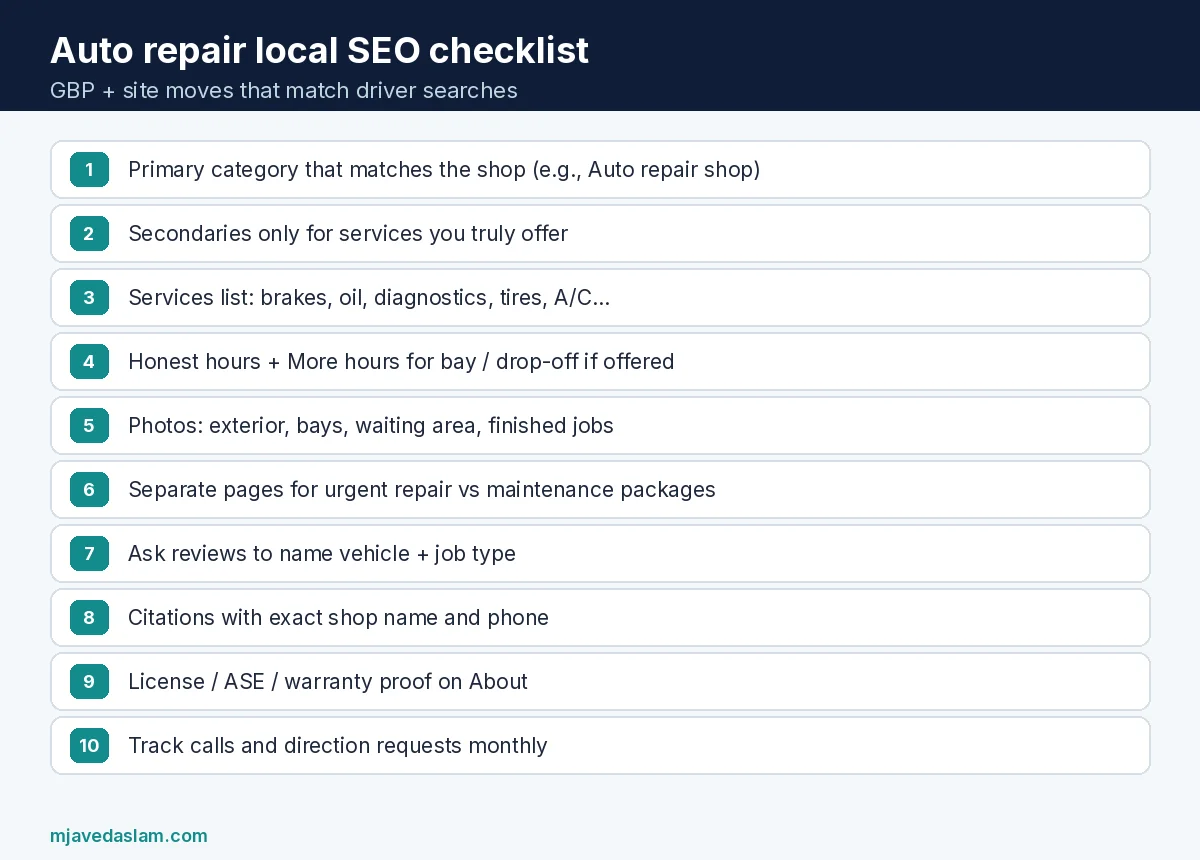
Local SEO for auto repair shops: the 10-point checklist
- Claim and verify the shop profile; keep the pin on the real bay entrance customers use.
- Choose the most accurate primary category (often Auto repair shop) — confirm in the live picker.
- Add secondaries only for services you truly sell (oil change, tire shop, auto glass, etc.).
- Fill the Services list with the jobs you want to rank for (brakes, diagnostics, A/C, tires…).
- Publish honest hours — and More hours / Special hours when drop-off or holiday schedules differ.
- Upload photos of exterior, bays, waiting area, and finished work (policy-safe, no logos you don’t own).
- Build separate site pages for urgent repair vs maintenance packages — not one vague “auto services” blob.
- Ask for reviews that name the vehicle and job type.
- Keep NAP identical on the site, GBP, and major directories.
- Track calls, messages, and direction requests monthly; fix weak landing pages before buying more ads.
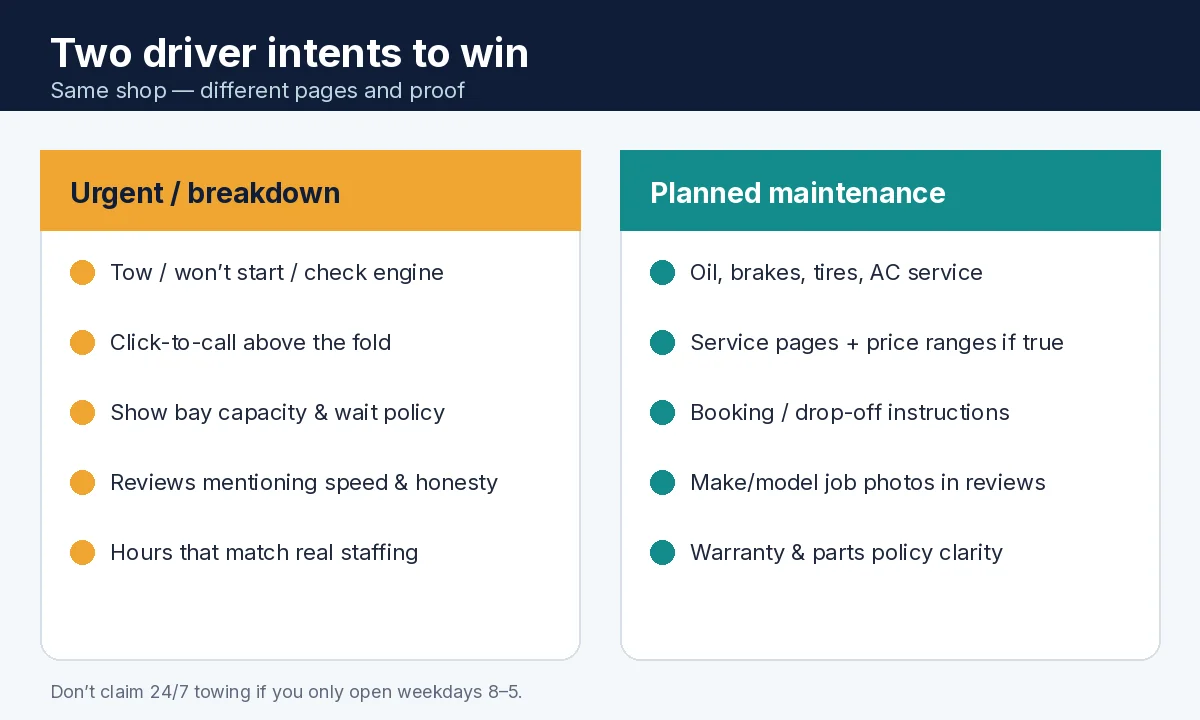
Urgent vs planned: split the driver intent
- Urgent / breakdown: won’t start, warning lights, flat, overheating, tow-in. Optimize for click-to-call, clear “what to do next,” wait/tow policy, and reviews that mention speed and honesty.
- Planned maintenance: oil, brakes, tires, alignments, A/C recharge, inspections. Optimize for service pages, appointment/drop-off instructions, warranty language, and photo proof of tidy finished work.
Do not advertise 24/7 roadside if you only staff weekdays 8–5. Misleading hours and categories violate representation guidelines and burn trust when a stranded driver arrives to a locked gate.
Google Business Profile specifics for auto shops
- Categories: Primary should match what you mainly are. Secondaries support real departments — don’t add “Car dealer” if you only repair. Manage categories in the official category Help flow — primary category guide.
- Services: Use Manage services to list brakes, oil changes, engine diagnostics, tire services, and other work you perform. Skip services you refer out.
- Description: Years open, ASE/tech credentials if true, makes you specialize in, warranty highlights, cities/neighborhoods served — description tips.
- Photos & videos: Storefront signage, bay safety, waiting room, before/after pads/rotors (customer-permitted). Follow the photos/posts content policy — photos guidelines.
- Posts: Seasonal A/C checks, winter tire Offers with real dates, “loaner/shuttle today” Updates — posts best practices.
- Chat / booking: Enable messaging only if advisors answer — GBP messaging. Add a booking link when your scheduler is reliable (separate booking article covers the how-to).
- Hours: Align holiday Special hours early — holiday hours.
Website pages that support both search types
- /auto-repair/ or diagnostics hub — warning-light FAQ, safety notes, call CTA above the fold.
- /oil-change/, /brake-repair/, /tire-services/, /auto-ac-repair/ — planned-intent pages with process, parts policy, and typical timelines (no invented “average prices” unless you publish real ranges you honor).
- /about/ — owners, certifications, warranty, insurance.
- /contact/ or booking — map, parking/drop-off instructions, after-hours towing partners if you use them.
- City pages only if you truly operate there — avoid doorway clones.
Technical trust still matters: LocalBusiness schema that matches the visible NAP — LocalBusiness schema — and pages that load on mobile in the parking lot — Core Web Vitals.
Reviews and trust signals drivers notice
Ask happy customers to mention the vehicle (make/model) and the job (“rear brakes on a 2018 Civic,” “same-day serpentine belt”). Speed and upsell honesty comments help urgent intent; cleanliness and explanation comments help planned intent. Reply to every review with specifics — review templates.
Show ASE or manufacturer training where true, written warranty terms, and photos of organized bays. Fake review schemes and incentivized star-only asks are not a strategy — they risk profile trouble and customer backlash.
Citations, ads, and measurement
- Match shop name, address, phone, and website on major auto and local directories.
- Google Ads can cover high-intent emergency terms while organic pages mature — watch match types, negatives, and budget reality — match types, negatives, cost ranges.
- In GBP Insights, watch calls, direction requests, website clicks, and which services get views. If oil-change pages get traffic but zero calls, fix the CTA or phone tracking before rewriting the whole site.
Full-stack help when you want it done with you: local SEO, Google Business Profile, SEO.
Internal linking tip: from every urgent page, link to contact/call and towing guidance; from every maintenance page, link to warranty/about and booking. Keep service menus identical in the footer and GBP Services list so drivers are not surprised at the counter.
Multi-location groups should localize each shop’s photos, hours, and reviews — a downtown waiting-room photo on a highway bay profile looks careless. When posting Offers across locations, rewrite city-specific details.
If the listing is suspended or duplicated after a rebrand (new DBA on the same bay), fix that before pouring ad spend into the wrong Place ID — duplicate GBP, claim/verify.
Example content sprint for a two-bay independent shop: Monday photograph three finished jobs; Tuesday publish brake and oil pages with those photos; Wednesday update GBP Services and categories; Thursday ask five recent customers for make/model reviews; Friday schedule one seasonal post. Repeat monthly. That beats a 40-page “ultimate auto SEO” PDF nobody implements.
Parts and pricing honesty converts. If you quote after diagnosis, say so on the diagnostics page. If you price-match national oil coupons with conditions, publish the conditions. Drivers who feel bait-and-switched leave the review you cannot bury with more citations.
Seasonal calendar that actually moves the needle: spring A/C performance posts and pages, late-summer brake/tire safety Checks before holiday travel, fall battery/alternator education, winter emergency kit + tow policy clarity. Tie each season to one GBP Offer or Event with real dates and one site FAQ update — not twelve thin blog posts.
Advisor script for review asks (say it at pickup, not three weeks later): “If we explained the repair clearly and treated your [make/model] right, would you share that on Google? Mentioning the job helps the next driver.” Hand them a short link or QR — then reply publicly when the review lands.
Finally, keep paid and organic landing pages honest about diagnosis fees and wait times. Ranking for “cheap oil change” while surprising drivers with mandatory upsells destroys the prominence you just earned. Local SEO compounds when the bay experience matches the Search promise.
FAQ: local SEO for auto repair shops
What is the best Google primary category for an auto repair shop?
Often Auto repair shop when that matches the business. Confirm in the live category picker and only add secondaries you truly offer (oil change, tires, glass, and so on).
Should auto shops optimize for “near me” emergency searches?
Yes — with honest hours, click-to-call, clear urgent-service pages, and reviews that mention fast, fair diagnosis. Don’t claim capabilities or hours you don’t staff.
Do I need separate pages for oil changes and brakes?
Yes when those are core revenue jobs. Separate pages match planned-intent queries better than one generic “auto services” page.
How important are Google reviews for auto repair SEO?
Reviews influence prominence/popularity signals and conversion. Job- and vehicle-specific comments help relevance for both urgent and maintenance queries.
Can I use the same SEO checklist as plumbers or electricians?
Share the local foundations, but auto shops need automotive categories, bay/drop-off clarity, and make/model review proof — don’t paste another trade’s playbook wholesale.
Should I buy Google Ads for auto repair keywords?
Ads can cover high-intent terms while organic pages grow. Use tight match types, negatives for DIY parts queries you don’t want, and conversion tracking on calls.