Local SEO for lawyers is how solo and small firms show up in the Map Pack and organic results when nearby people search for a practice area — divorce attorney, DUI lawyer, estate planning near me — without stuffing city names into the firm name or promising outcomes Google and your state bar will not allow.
This is the lawyer vertical playbook: Google Business Profile accuracy, ethical representation, practice-area pages, and reviews. It is not legal advice, not a substitute for your state bar’s advertising rules, and not the generic Map Pack checklist or other trade verticals (plumbers, dentists, landscapers).
Hands-on local work: local SEO services.
Local SEO for lawyers — quick answer
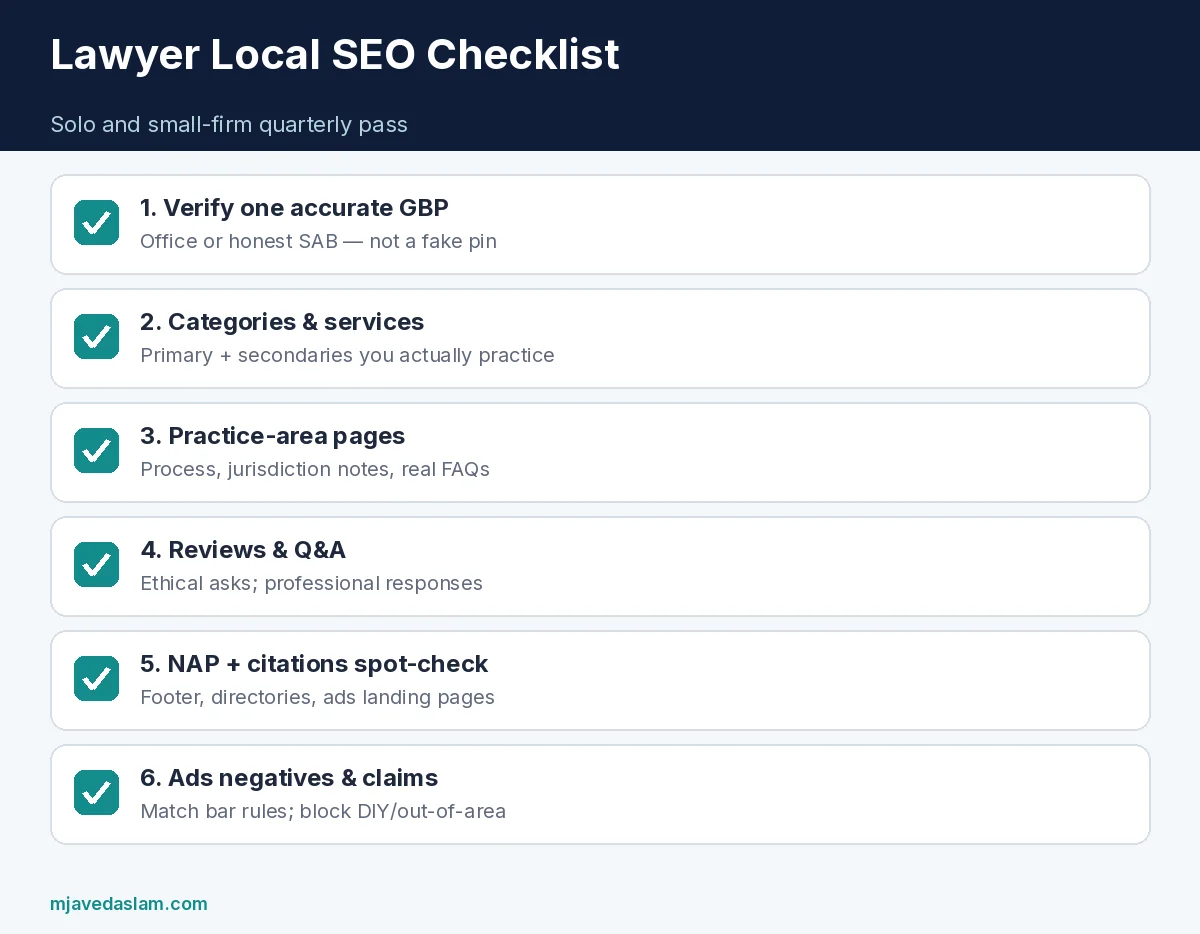
- Claim and verify one accurate Google Business Profile for the real office (or a correctly configured service-area setup if you truly have no public walk-in desk — see Google’s SAB guidance).
- Pick the most accurate primary category in the live picker (often Lawyer, Attorney, or a practice-specific category that matches your money work) and only add secondaries you actually practice.
- Write a description and website copy that state who you help and where — without outcome guarantees, fake “#1” claims, or keyword-stuffed titles that break Google’s representation guidelines and many bar advertising rules.
- Build practice-area pages with real process, jurisdiction notes, and FAQs; city or county pages only where you have capacity and unique proof — no doorway spam.
- Ask for honest reviews after matters conclude (where rules allow); respond professionally; never buy reviews or script false praise.
Google’s local ranking Help still frames results around relevance, distance, and prominence. You cannot pay for organic Map Pack rank. Categories, services, reviews, and a useful site support relevance and prominence; distance is geography.
Ethics first: marketing is not legal advice
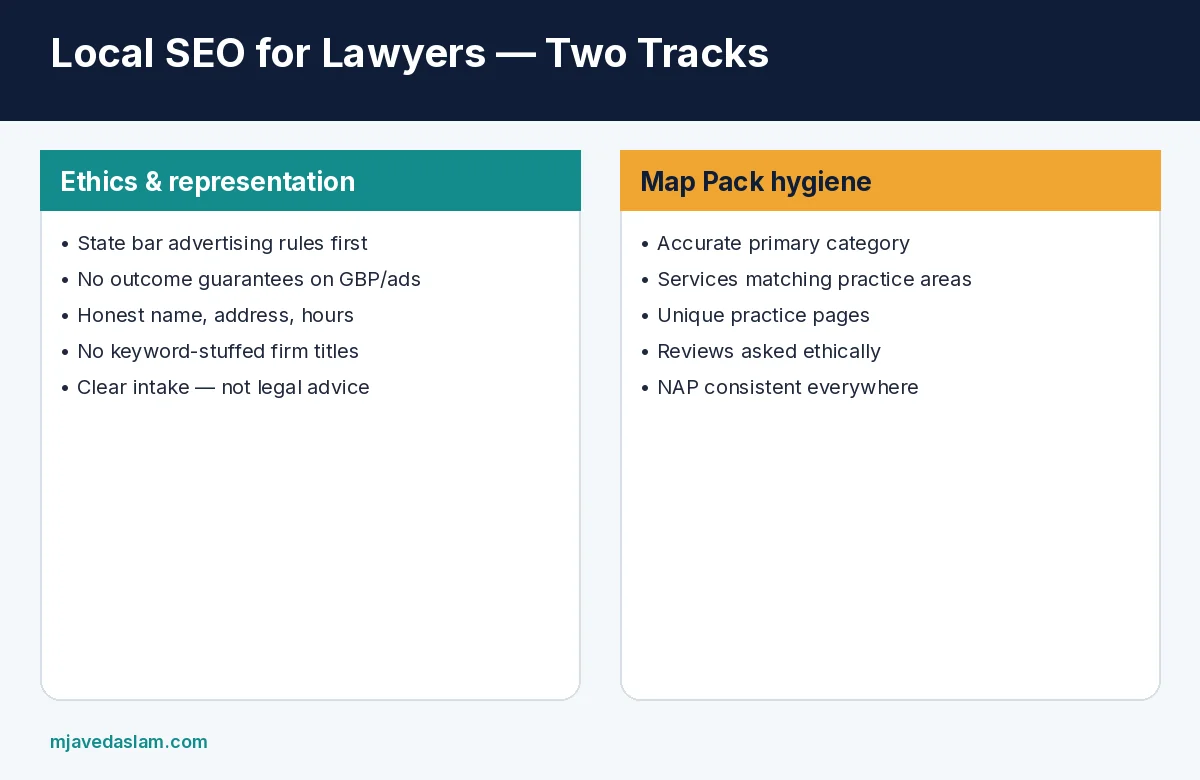
Nothing in this article is legal advice. Advertising and solicitation rules differ by jurisdiction. Many U.S. states adapt frameworks similar to the ABA Model Rules on communications about a lawyer’s services (commonly discussed as Rules 7.1–7.3 territory — verify your state rules and any required disclaimers). Before you publish rankings claims, “guaranteed” results, actor testimonials, or aggressive intake CTAs, clear them with ethics counsel or your bar’s advertising guidance.
On Google Business Profile, follow Google’s representation guidelines: the name, categories, address, and hours must match how the firm really operates. Keyword stuffing the business name (“Best Divorce Lawyer City1 City2”) is a common suspension trigger and looks unprofessional to referral partners.
Categories, services, and practice-area clarity
Open the live category picker — labels change. A personal-injury boutique and a general practice should not share an inaccurate primary. Add secondary categories only for work you perform. Use the services editor so Maps can surface offerings: GBP products and services. Mirror search language (“estate planning,” “criminal defense consult”) rather than internal matter codes. Pair with a clear primary category guide: primary category.
Keep the GBP description factual: practice areas, languages, appointment norms. Skip outcome promises. More on tone: GBP description.
Office address vs service-area honesty
If clients visit a real office, show that address consistently on the site, citations, and GBP. If you are a pure service-area firm with no public desk, configure the profile as Google documents for service-area businesses — do not invent a virtual office pin to game distance: service-area business GBP.
Multi-office firms need one profile per real location (Google’s multi-location rules), not cloned “City A divorce” profiles for the same desk. Duplicate mess: fix duplicates.
Website pages that convert intake (without doorway spam)
- One strong page per major practice area with process, who you serve, jurisdiction notes, and FAQs — not thin city clones.
- County or city pages only where you have unique proof (court familiarity, local office, published articles) and real capacity.
- Clear intake paths: call, form, calendaring link if you use one — track ads properly: conversion tracking.
- Schema that matches visible services without duplicate LocalBusiness graphs: service page schema; base LocalBusiness notes: LocalBusiness schema.
Map Pack fundamentals still apply: how to rank in the Map Pack. Service-area landing page hygiene (no doorway spam): planned companion in this batch — and Google’s spam policies on doorway abuse.
Reviews, Q&A, and reputation for firms
Ask for reviews where your ethics rules permit, after the matter is appropriate to request feedback. Respond to every review with professionalism — no arguing privileged facts in public. Template patterns for tone (adapt for firm voice): review response templates. Do not buy reviews or gate them in ways that break Google’s policies.
Monitor leftover Q&A / Ask-style answers so inaccurate legal statements do not sit unanswered: GBP Q and A. Photos of the real office, team (with consent), and accessibility matter more than stock gavel montages: photos guidelines.
Ads support without ethics landmines
Search ads for high-intent practice terms can fill gaps when organic lags. Use negatives for DIY, jobs, and out-of-jurisdiction cities: negative keywords. Landing pages must match ad claims and bar rules. Full Ads help: Google Ads services.
Common lawyer local SEO mistakes
- Keyword-stuffed firm names and fake suite addresses.
- One lonely homepage and empty GBP services.
- Twenty identical “best lawyer in [suburb]” pages with no unique content.
- Outcome guarantees or unverifiable “#1 in the city” badges on GBP and ads.
- Ignoring NAP consistency across directories and the footer.
- Creating separate profiles for every practice area at the same desk.
Ops checklist (quarterly)
- Audit categories and services against matters you actually take.
- Refresh office and team photos; confirm hours and holiday closures.
- Review top practice pages for outdated statutes or process language (have counsel sign off).
- Sync ads sitelinks with current intake offers (consult type, languages).
- Spot-check NAP on major citations and the site.
Solo firms often win on clarity: one honest office story, two or three practice pages done well, and steady review responses beat a bloated blog of thin city posts.
If you co-counsel or refer out of area, say so on the site — surprise handoffs create review pain faster than ranking pain.
Intake forms should ask only what you need for conflict checks and scheduling — long public questionnaires that solicit privileged detail on an unsecured form create risk that has nothing to do with rankings. Keep sensitive follow-up inside your matter-management workflow.
Bilingual firms should mirror language claims on GBP attributes, the site, and ads sitelinks so callers are not surprised. If only one attorney is fluent, say so — overselling language access shows up in reviews.
When you sponsor local events or CLE-adjacent community talks, earn a citation with consistent NAP rather than a second “event” Google profile. One accurate pin beats a festival of unofficial listings.
Referral-only practices still benefit from a complete GBP: hours for messages, a clear “by referral / intake screening” note in the description, and a website that sets expectations before the first call. Empty profiles get claimed by someone else or confused with similarly named firms.
If a partner leaves and takes a book of business, update the team page and any attorney-specific URLs promptly. Stale “meet the team” blocks with departed lawyers are an ethics and trust problem before they are an SEO problem.
Compare your practice-area pages against competitors’ thin city spam: your differentiator is process clarity and jurisdiction honesty, not another synonym for “best attorney.” Pair this vertical with the Map Pack fundamentals and the service-area landing page guide when you expand counties.
FAQ: local SEO for lawyers
What Google Business Profile category should lawyers use?
Choose the most accurate primary in the live picker (often Lawyer, Attorney, or a practice-specific category that matches your work). Confirm labels in your account — names vary — and only add secondaries you practice.
Can I put every city I serve in the firm name?
No. Google’s guidelines prohibit keyword stuffing in the business name. List service areas in the appropriate fields and on the website instead.
Are city landing pages allowed?
Useful, unique pages for areas you truly serve can help users. Thin doorway pages that exist only to rank for city+practice queries risk spam classification — see Google’s doorway abuse policy.
Is this legal advice?
No. Local SEO tactics are marketing operations. Advertising rules, confidentiality, and solicitation limits are legal/ethics questions for your counsel and state bar.
Do reviews help Map Pack rankings?
Reviews support prominence and trust. Google does not publish a guaranteed lift percentage for review count. Ask ethically; never buy fakes.
Should every practice area have its own GBP?
Usually no — one profile per real location. Differentiate practice areas with services and website pages, not duplicate profiles for the same office.
Need help aligning GBP and practice pages without the spam traps? Start at Google Business Profile services or services overview.