

Local SEO for landscapers is how lawn care and landscaping companies show up in the Map Pack and organic results when homeowners search for mowing, cleanup, sod, hardscape, or snow (where you offer it) near them. Seasonal demand swings hard — spring cleanup and fall leaf removal are not the same campaign as a July mow route — so your Google Business Profile, service pages, and ads creative should track the calendar, not a static brochure.
This is the landscaper vertical playbook. It is not the generic Map Pack checklist, plumber/HVAC/roofer guides, or a GBP suspension tutorial.
Hands-on local work: local SEO services.
Local SEO for landscapers — quick answer
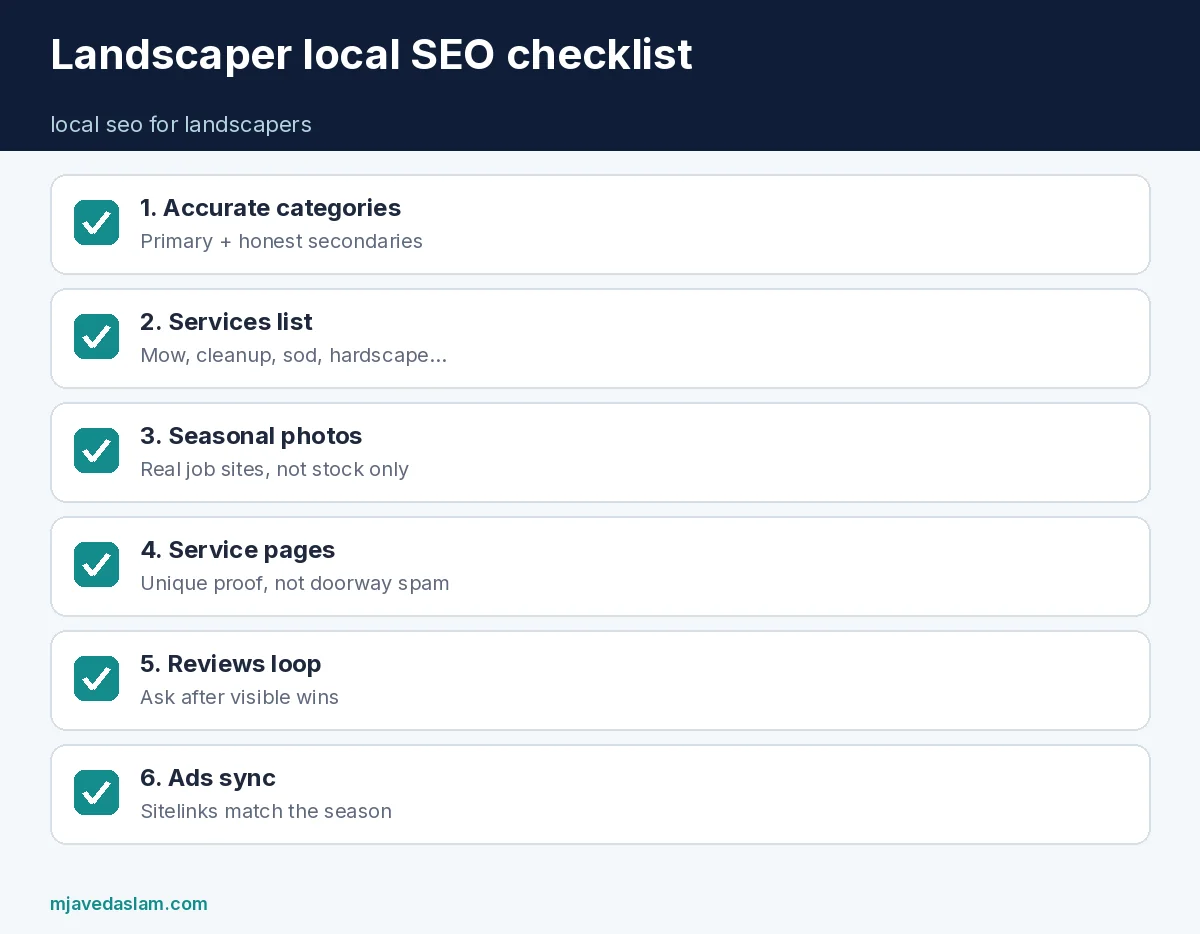
- Claim and verify Google Business Profile with an honest primary category (often Landscaper, Lawn care service, or the closest accurate pick in the live picker) and complete secondary categories you truly offer.
- Fill services with the jobs customers search: weekly mow, aeration, mulch install, spring cleanup, irrigation repair — with clear descriptions; prices only if you will honor them.
- Publish seasonal photos and posts when crews are actually doing that work; geotagged job-site photos beat stock lawns.
- Build service pages for major offerings and cities you genuinely cover — no doorway spam. Align NAP and service areas with the profile.
- Ask for reviews that mention the service and neighborhood in natural language after completed jobs.
Google’s local ranking Help still frames results around relevance, distance, and prominence. You cannot pay for organic Map Pack rank. Categories, services, reviews, and a useful site support relevance and prominence; distance is geography.
Categories and services that match lawn search intent
Open the live category picker — labels change. Pick the primary that best matches the money work (a design/build firm and a pure mow route should not share the same primary if one is inaccurate). Add secondary categories only for services you perform. Stuffing unrelated categories violates representation guidelines.
Use the services editor so Maps can surface offerings: GBP products and services. Mirror search language (“yard cleanup,” “sod installation”) rather than internal SKU codes. Pair with a clear primary category guide: primary category.
Seasonal search strategy (US lawns)
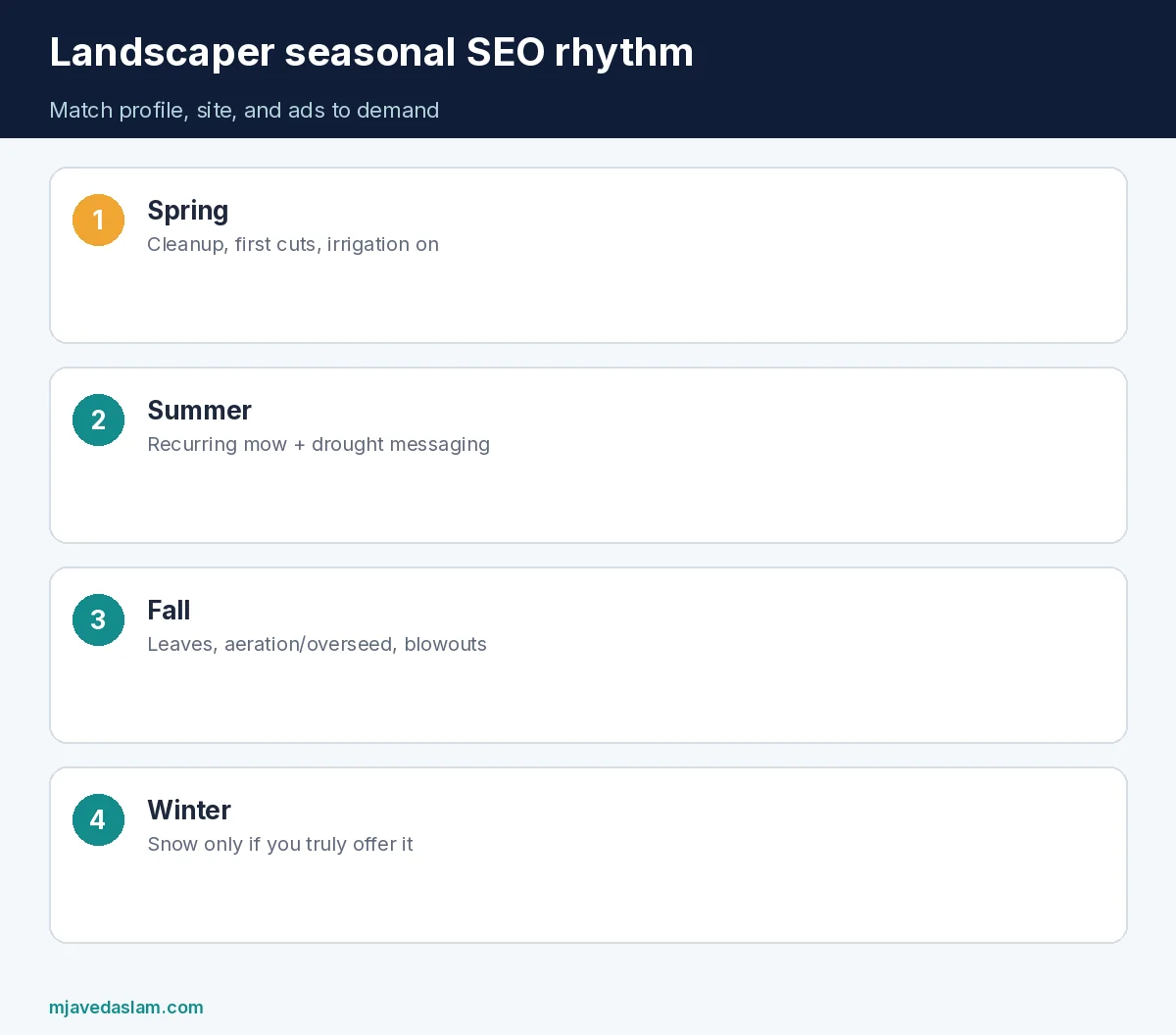
Demand curves differ by climate zone, but many US markets share a rhythm:
- Late winter / early spring: cleanup, bed prep, first cut, fertilization kickoff, irrigation turn-on.
- Peak summer: recurring mow, drought stress communication, mulch touch-ups, outdoor living installs where you sell them.
- Fall: leaf removal, aeration/overseed (where agronomically sane), final cuts, irrigation blowouts in freeze zones.
- Winter (snow markets): if you offer snow, treat it as a separate service line with honest hours and response expectations — do not leave summer-only photos as the only story.
Update GBP posts, website banners, and Google Ads sitelinks before the rush — not two weeks after competitors already booked. Holiday and seasonal hours on the profile matter when storms change schedules: holiday hours.
Photos, proof, and before/after without policy pain
Follow Google’s photo guidelines: real places, no heavy text spam, no misleading stock that is not your work. Before/after sequences from jobs you completed build trust; watermark spam and collage overload do not. Crew headshots and equipment yards help when they match representation rules. Deep dive: photos guidelines.
Video verification exists for some profiles — separate from landscaping SEO tactics: video verification.
Website pages that convert seasonal calls
- One strong page per major service (mowing, cleanup, hardscape, irrigation) with process, service area honesty, and FAQs.
- City pages only where you have capacity and unique proof — not twenty cloned “best landscaper in X” posts.
- Clear click-to-call and estimate forms; track calls if you run ads: conversion tracking.
- Schema that matches visible services without duplicate LocalBusiness graphs: service page schema.
Map Pack fundamentals still apply: how to rank in the Map Pack.
Reviews and reputation for crews
Ask after a visible win (first spring cleanup, sod install day). Respond to every review with specifics — template patterns: review response templates. Do not gate or incentivize reviews in ways that break Google’s policies. When a review mentions a street or HOA, that natural geographic language helps relevance more than stuffing city names into your business title (which guidelines forbid).
Ads support without torching the mow margin
Search ads for high-intent seasonal terms can fill gaps when organic lags. Use negatives so “jobs,” “DIY,” and out-of-area cities do not drain budget: negative keywords. Call assets help mobile callers; see the call-ads transition notes in the Ads cluster. Full Ads help: Google Ads services.
Common landscaper SEO mistakes
- Keyword-stuffed business names (“Best Landscaping City1 City2 City3”).
- One lonely homepage and an empty services list on GBP.
- Stock-only photos that look nothing like local yards.
- Service-area claims covering three states with a two-truck crew.
- Ignoring fall/winter messaging until the phone goes quiet.
- Creating duplicate profiles for “lawn” and “snow” brands without a real separate business — duplicates create mess: fix duplicates.
Ops calendar (quarterly)
- Audit categories and services against what crews actually book.
- Refresh 10+ recent job photos each peak season.
- Rewrite the top service page intro for the upcoming season.
- Sync ads sitelinks and GBP posts with the same offers.
- Check NAP on citations and the site footer.
Owner-operators who sell design/build plus maintenance should separate those stories on the site so quote expectations stay sane. A $40 mow searcher and a patio remodel searcher need different landing pages.
If you subcontract snow or tree work, say so in services and on the site — surprise subcontracting shows up in angry reviews faster than in rankings.
Multi-crew companies should give each market manager authority to update local photos and posts; HQ-only calendars lag real weather.
FAQ: local SEO for landscapers
What Google Business Profile category should landscapers use?
Choose the most accurate primary in the live picker (often Landscaper or Lawn care service). Confirm labels in your account — names vary — and only add secondaries you perform.
Do seasonal GBP posts help rankings?
Google does not publish a ranking guarantee for posts. Posts help communicate current offers and keep the profile useful; treat them as customer communication first.
Should I create a page for every suburb?
Only when you can add unique proof and will actually serve that area. Thin doorway pages waste crawl budget and trust.
Can I pay Google to rank organically in the Map Pack?
No. Local ads are paid placement; organic local results use relevance, distance, and prominence.
How important are reviews for landscapers?
Reviews contribute to prominence and trust. Ask for them after completed work and respond thoughtfully — do not buy fake reviews.
What about hardscape vs lawn care on one profile?
One real business can list both via categories and services if both are accurate. Separate brands need separate profiles that follow guidelines.
Local SEO for landscapers rewards honest categories, seasonal proof, and pages that match how homeowners actually hire crews. Keep the profile and site on the same calendar as your trucks.
Keep documentation in your ops folder: screenshot the live UI quarterly, store the Help URLs you relied on, and note the date you last verified settings. Interfaces move; your runbook should move with them.
When something conflicts between an old blog post and current Google Help, trust Help — then update your internal SOP the same day so the next teammate does not relearn a sunset feature.
Snow-market landscapers should publish a separate winter FAQ covering response windows, contract minimums, and which surfaces you clear — then mirror those facts on the Business Profile services list before the first storm forecast hits local news.
Design/build firms benefit from a project gallery page with completion years and materials, linked from hardscape service pages, so Map Pack clickers land on proof instead of a thin contact form.
If you use subcontractors for trees or lighting, disclose that on the relevant service page and in estimate scripts; surprise third parties are a reputation problem before they are an SEO problem.
Revisit category choices annually when you add irrigation or outdoor living — an outdated primary category fights the services list you just improved for local SEO for landscapers.