To optimize content for Google AI Overviews, write unique, non-commodity pages that answer the query with clear structure, first-hand proof, and crawlable HTML — the same foundations Google documents for generative AI features in Search. There is no special “AI Overview schema,” no guaranteed llms.txt trick, and no substitute for being the source worth citing. This guide is a format and evidence checklist for SMBs; it is not “how to get cited” case studies alone, AI Mode explainers, or ChatGPT brand-mention tactics.
Related presence angles stay separate: get cited in AI Overviews, AI Overviews vs featured snippets, what is Google AI Mode.
SEO help: SEO services.
Optimize content for Google AI Overviews — quick answer
- Create non-commodity content: first-hand experience, original data you actually collected, or a viewpoint someone else could not copy-paste from ten SERP clones.
- Structure for humans: descriptive H2/H3s, short answer blocks near the top, lists and tables when they clarify — not keyword-stuffed doorway pages for every fan-out query.
- Keep pages crawlable and indexable: allow Googlebot, avoid blocking critical content behind non-rendered walls, make important text visible in HTML.
- Align structured data with visible text; do not invent FAQ or HowTo markup that is not on the page.
- In Search Console, understand the Search generative AI control (sitewide inclusion settings for generative AI features) and monitor performance reports Google provides — without chasing unofficial “AEO hacks.”
Google’s Search Central AI features documentation and the 2026 generative AI optimization guide emphasize helpful unique content, technical accessibility, and myth-busting around special markup. The Search Console Help documents a Search generative AI control for managing inclusion in features such as AI Overviews and AI Mode (rollout timing can vary — check the live Help note in your account).
Format checklist Google’s guidance actually supports
- Unique point of view: First-hand reviews, process write-ups from jobs you ran, and original photos beat recycled “7 tips” commodity posts.
- Clear organization: Paragraphs and headings people can scan; generative systems also benefit when structure is coherent.
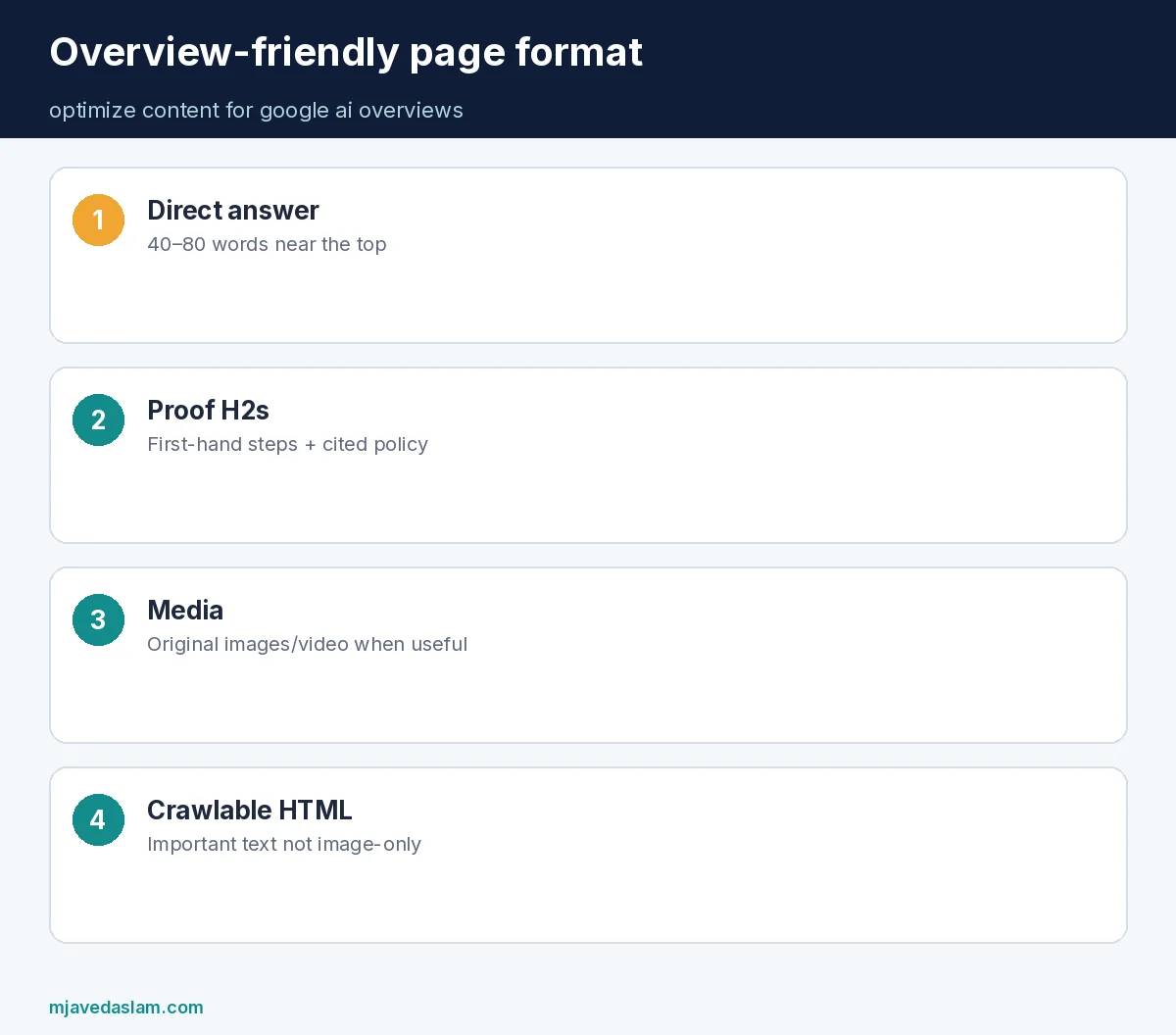
- Evidence on the page: Named methods, dates, constraints, and “what we would not do” caveats. Vague authority language without proof is weak.
- Relevant media: High-quality images and video when they help — follow image/video SEO basics Google already publishes.
- One strong page > twenty thin variants: Creating separate URLs for every query paraphrase primarily to manipulate rankings or generative responses can violate scaled content abuse policies.
If you use generative tools to draft, Google still expects the published work to meet Search Essentials and spam policies. Human editing for accuracy is not optional.
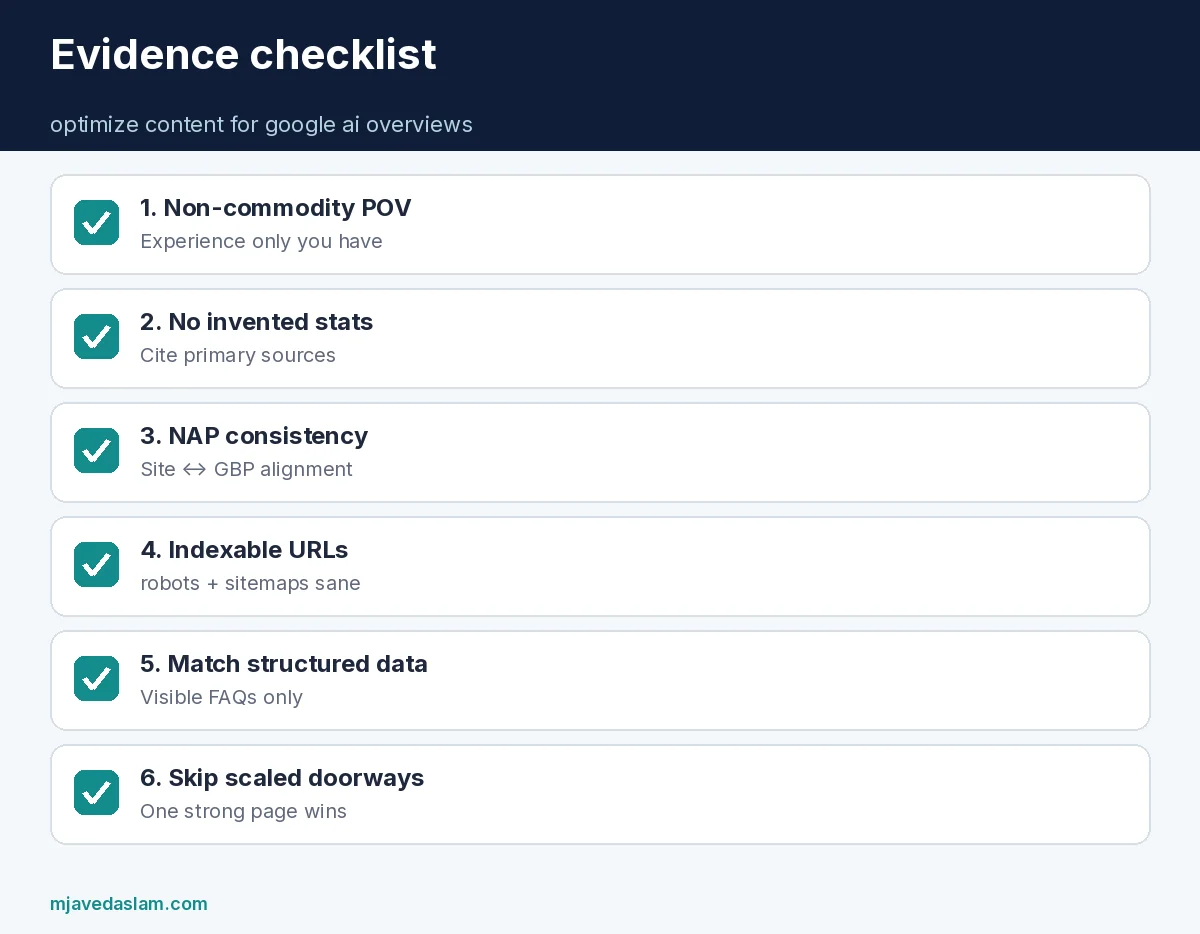
Evidence checklist for local and service SMBs
- Show real service areas and limitations (hours, response windows) instead of nationwide brag copy you cannot fulfill.
- Cite primary sources (Google Help, regulations, manufacturer specs) with links — and do not invent statistics.
- Keep NAP, services, and offers consistent with Google Business Profile and on-site pages.
- Publish author or business credentials that match reality — EEAT habits: EEAT checklist.
- Update pages when policies change (for example Ads or GBP feature sunsets) instead of leaving 2022 screenshots forever.
Technical hygiene that still matters
AI features need access to your content. Practical checks:
- robots.txt and CDN rules are not blocking Googlebot from key URLs — WordPress robots.txt with Yoast.
- XML sitemaps submitted and sane: Yoast XML sitemap settings.
- Core content in HTML, not only images of text.
- Reasonable page experience; fix CWV pain: fix Core Web Vitals.
- Internal links so important guides are discoverable — orphan posts rarely become the cited source.
Structured data should match visible content (LocalBusiness, FAQ when real FAQs exist, breadcrumbs). It is not a secret Overview key. Service page markup: schema for local service pages.
What not to do (myth busting)
- Do not buy “AI Overview submission” services that promise placement.
- Do not spam identical AI-generated city pages.
- Do not hide the answer in an accordion Googlebot cannot see while showing a different answer to users.
- Do not confuse being mentioned in ChatGPT with ranking in Google AI Overviews — different systems: ChatGPT brand mentions.
- Do not ignore the Search generative AI control if you intentionally need to limit generative reuse — read Search Console Help before changing sitewide settings.
Editorial workflow I use with clients
- Pick a query the business can answer with proof.
- Write a 40–80 word direct answer near the top.
- Expand with H2 sections that mirror real sub-questions (PAA-style), each backed by experience or cited policy.
- Add one original figure, checklist, or photo from their operation.
- Trim commodity paragraphs that any competitor could swap logos on.
- Publish, request indexing if needed, then improve from Search Console queries — not from rumor threads.
Measure patiently. Google does not publish a simple “Overview CTR guarantee,” and feature eligibility varies by query and region.
FAQ: optimize content for Google AI Overviews
Is there special schema for AI Overviews?
Google’s guidance stresses standard SEO and helpful content. Do not rely on unofficial “AEO schema” products that promise Overview slots.
Do I need llms.txt to appear in AI Overviews?
Google’s published AI optimization guidance focuses on crawlability, unique content, and existing Search controls — not an llms.txt requirement for Overviews. Follow official Search Central docs over Twitter threads.
Should I write separate pages for every AI fan-out question?
Usually no. Scaled near-duplicate pages built to manipulate generative responses risk spam policy issues and waste effort.
How is this different from featured snippet SEO?
Snippets and Overviews are different presentations. Clear answers still help people; see the comparison post rather than merging tactics into one keyword.
Can I opt out of generative AI features?
Search Console documents a Search generative AI control for managing inclusion in listed generative AI features. Read the live Help page before changing it — impacts are sitewide for those features.
Does EEAT still matter?
Experience, expertise, authoritativeness, and trust signals remain practical for helpful content. They are not a secret ranking formula you can “score” with a plugin.
When you optimize content for Google AI Overviews, bet on being the clearest honest source — not on a new file format or a markup gimmick. Format for humans, prove claims, stay crawlable, and keep the page updated when the facts change.
Local businesses should pair this editorial bar with a complete Business Profile and service pages that match what crews actually do. Generative features that summarize the local web still need accurate raw material.
Refresh cornerstone guides when Google ships major Help changes (Ads sunsets, GBP feature shifts). Stale tutorials that contradict current policy are poor candidates for citation.
Keep documentation in your ops folder: screenshot the live UI quarterly, store the Help URLs you relied on, and note the date you last verified settings. Interfaces move; your runbook should move with them.
When something conflicts between an old blog post and current Google Help, trust Help — then update your internal SOP the same day so the next teammate does not relearn a sunset feature.
When refreshing a cornerstone guide, keep a changelog near the bottom with the date and what policy links you re-verified — readers and future you both benefit when AI features surface older URLs.
Local service brands should include constrained claims (“same-week installs in these ZIP lists when capacity allows”) instead of absolute promises generative summaries might overstate.
Internal subject-matter experts should review technical sections even when a marketer drafts the outline; unreviewed AI drafts are how inaccurate numbers sneak into pages you hoped to optimize content for google ai overviews with.
Finally, watch Search Console for queries where you already rank but the page is thin — those are better Overview candidates to improve than inventing twenty new URLs overnight.
Pair editorial upgrades with unbroken internal links from service pages and the blog index so crawlers and people both find the improved guide quickly.