People searching how to get your brand mentioned in ChatGPT usually want a shortcut into AI answers. Reality check first: OpenAI does not sell a public “pay to be named in ChatGPT” package for ordinary small businesses, product behavior changes over time, and no reputable playbook can guarantee a mention. What you can do is make your brand easier for people — and for systems that read the public web — to describe accurately: consistent identity, earned coverage, useful pages, and honest expertise.
This is not “how to get cited in Google AI Overviews,” not “what is AI Mode,” and not an E-E-A-T checklist rewrite. Those Google-side guides stay separate. Here the angle is ChatGPT brand visibility with SMB-realistic steps and zero fake guarantees.
Practical SEO help: SEO.
How to get your brand mentioned in ChatGPT (realistic quick answer)
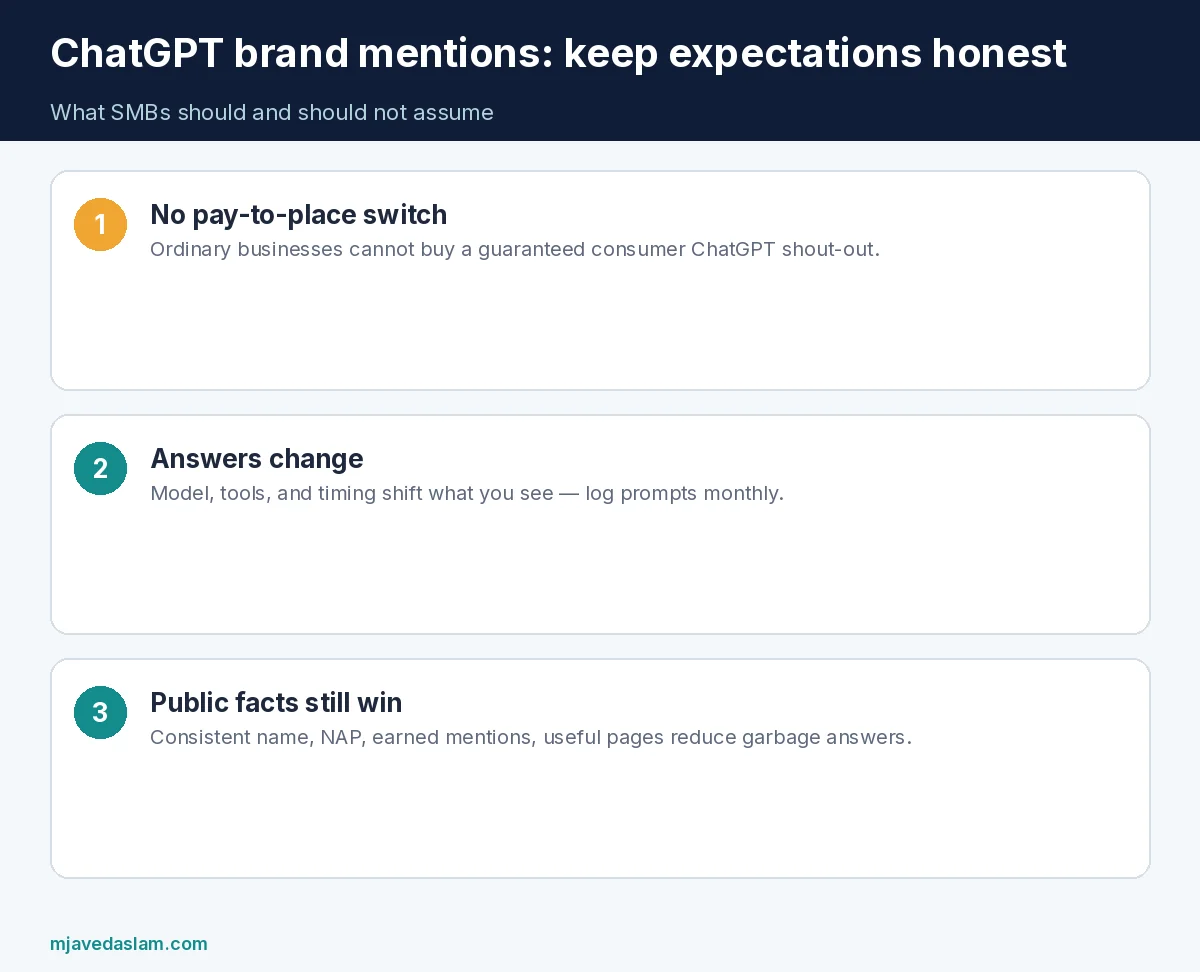
- Accept uncertainty: ChatGPT answers vary by model, tools/browsing mode, user history, and time. Treat mentions as a side effect of strong public presence — not a controllable SERP feature you toggle.
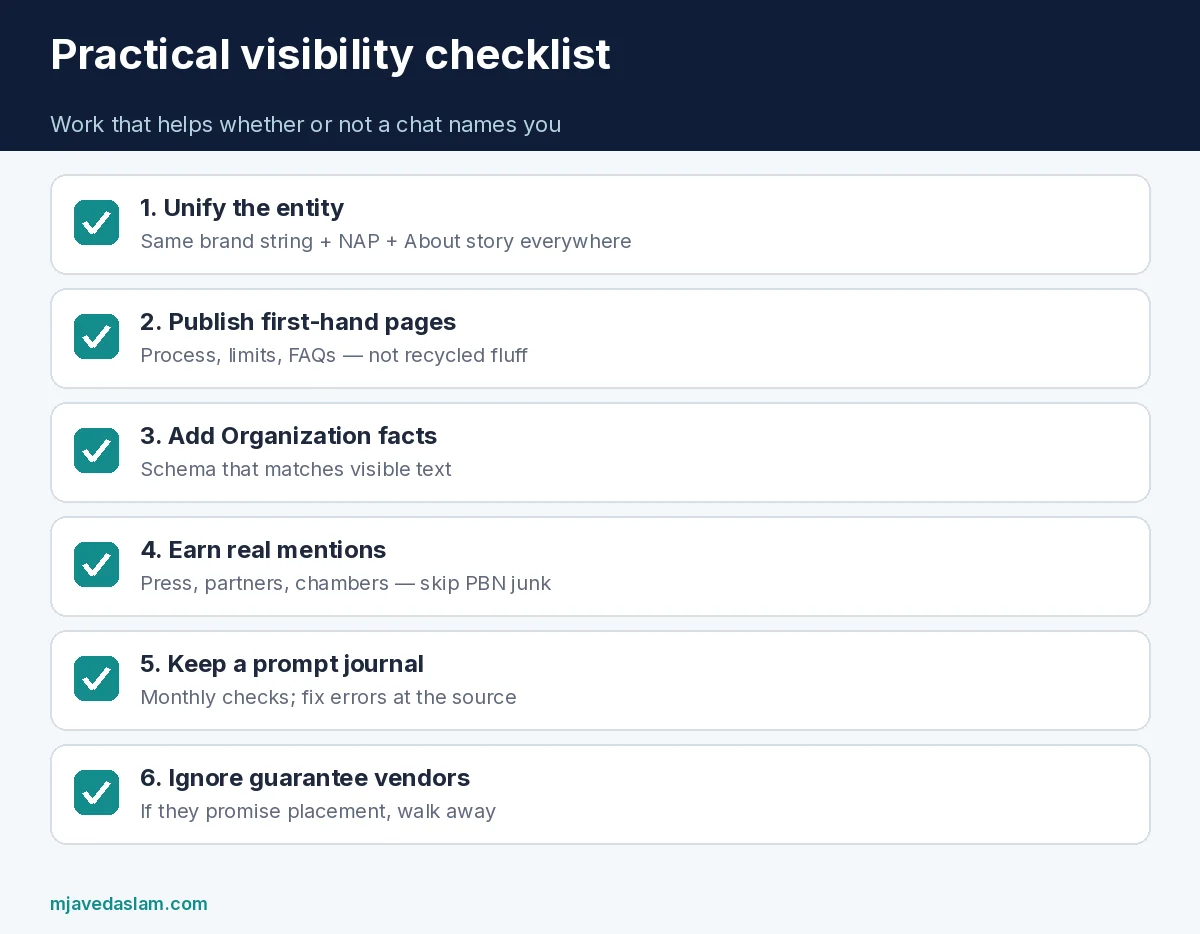
- Make the entity obvious: same legal/trade name, NAP, and “about” story on your site, Google Business Profile, and major profiles.
- Publish first-hand pages only you could write — services, process, pricing logic, FAQs — aligned with Google’s helpful-content guidance even though ChatGPT is a different product.
- Earn third-party mentions: local press, industry directories you actually belong to, partner pages, podcasts — not PBNs.
- Keep Organization / LocalBusiness details machine-readable on your site.
- Monitor with manual prompts monthly; log what appears; fix inaccurate public facts at the source.
- Do not buy “AI citation” packages that promise placement — if it sounds like a guarantee, walk away.
What we know (and what we do not claim)
ChatGPT is OpenAI’s conversational AI product (see public overviews such as Wikipedia’s ChatGPT article for product history context). Developers can build on OpenAI APIs (embeddings, retrieval patterns documented in OpenAI’s developer docs) — that is not the same as a local bakery controlling ChatGPT Consumer answers. Separately, Google documents how sites can succeed with Google AI features in Search; that is useful hygiene, not a ChatGPT ranking factor sheet.
- Do claim: clear, consistent, widely published facts help any reader — human or software — describe you correctly.
- Do not claim: a specific on-page trick, schema type, or directory submission that “forces” ChatGPT to name you.
- Do distinguish: Google AI Overviews / AI Mode citation tactics — get cited in AI Overviews, what is AI Mode, AI Overviews vs snippets — from ChatGPT brand mentions.
SMB steps that still make sense
- Entity cleanup (week 1). One canonical brand name string; matching NAP; About page with owners, service area, founding year if you share it; same story on GBP — GBP.
- Helpful site pages (weeks 1–3). Service pages with process, who it’s for, limitations; original photos; FAQs. Follow helpful-content spirit — E-E-A-T checklist.
- Structured facts. Organization / LocalBusiness schema that mirrors visible text — LocalBusiness schema.
- Earned mentions. Chamber, supplier “where to buy,” charity sponsorships, expert quotes to local journalists. Quantity of spam directories < quality of real references.
- Reviews as public proof. Specific Google reviews that name services — useful for humans and as web text — review replies.
- Prompt journal (ongoing). Once a month, from a logged-out session, ask neutral questions (“best [service] in [city] for [need]”). Screenshot. Note competitors named. Fix missing facts on your site; do not harass models.
- Correct errors at the source. If ChatGPT invents a wrong phone number, update every public profile that still shows the old one.
What does not work (or is too risky to try)
- Keyword stuffing “as featured in ChatGPT” on your homepage.
- Fake press releases on wire services nobody reads.
- Buying links from “GEO optimization” vendors who guarantee AI mentions.
- Scraping private conversations or trying to poison training data — unethical and useless for SMBs.
- Ignoring Google Search entirely because “AI will replace SEO.” People still search; AI answers still lean on public web quality — see Google’s AI features + helpful content docs for the Google side of that story.
How this overlaps marketing you should do anyway
If the only reason you fix your About page is ChatGPT, you are still doing the right work for customers, sales reps, and Google. Local pack fundamentals — Map Pack — and clean technical SEO — robots.txt, sitemaps — keep your facts discoverable. Brand mentions in AI chat tools are a lagging indicator of that clarity.
For category leaders in tiny towns, you may already be mentioned because there are few alternatives in public text. For competitive metros, expect long timelines and inconsistent answers. Measure branded search demand and inbound “I saw you mentioned…” calls — not vanity screenshots alone.
Teams building apps with OpenAI APIs can cite retrieval and embeddings documentation when they control the corpus — that is product engineering, not consumer ChatGPT SEO. Do not confuse the two in stakeholder meetings.
When you brief a writer on how to get your brand mentioned in ChatGPT style content, ask for accurate differentiators (warranty terms, response times you honor, certifications) instead of superlatives. Models and humans both mishandle fluff; both handle concrete facts better.
Share the prompt journal with leadership so expectations stay adult: AI answers wobble. The win is fewer factual errors about your brand across the web — whether or not a given chat names you on a given Tuesday.
If a competitor is named and you are not, compare their third-party coverage and review volume before rewriting your homepage headline for the tenth time. Often the gap is public proof, not adjective choice.
A note for owners who feel late to “AI SEO”
You are not behind because you skipped a TikTok tip about ChatGPT. Most small businesses win the next twelve months the same way they won the last twelve: answer the phone, publish true service pages, collect specific reviews, and keep NAP clean. Learning how to get your brand mentioned in ChatGPT is really learning to be legible on the public web — with an extra humility layer because chat UIs remix sources unpredictably.
Budget tip: put dollars into photography, review operations, and one improved service page before you put dollars into an “AI visibility” retainer. If an agency cannot show which public pages or mentions they will improve — only dashboards of unverifiable AI scores — keep shopping.
Legal/compliance: do not feed customer PII into public chat tools to “see what AI says about them.” Use anonymized prompts. Do not impersonate reviewers or invent awards in hopes a model will repeat them.
When ChatGPT is wrong about a competitor, resist the urge to dunk on social media. Correct your own facts; document the error internally; move on. Platforms change; your operations quality compounds.
Revisit this topic quarterly — product names, browsing modes, and disclaimers evolve. Update your prompt journal template when UI labels change, but keep the same core questions so trend lines stay comparable.
FAQ: how to get your brand mentioned in ChatGPT
Can I pay OpenAI to be recommended?
There is no credible public self-serve product that lets a typical SMB buy consumer ChatGPT recommendations. Be skeptical of anyone selling guarantees.
Is this the same as Google AI Overviews?
No. Different products, different interfaces. Practices that improve public accuracy help generally, but citation mechanics are not identical — see our Google-specific guides.
How long until ChatGPT names my business?
Nobody honest can promise a date. Focus on public accuracy and earned mentions; check prompts monthly.
Should I create a Wikipedia page?
Only if you meet Wikipedia’s notability and sourcing rules. Most small businesses will not — and promotional pages get deleted.
Do schema markup and EEAT help ChatGPT?
They help humans and Google understand you. Treat any ChatGPT benefit as unproven but aligned with good practice — not a silver bullet.
What should I track?
A monthly prompt journal, branded search trends, referral call reasons, and corrections to wrong public NAP/hours.