
E-E-A-T checklist for small business websites is a practical trust audit — Experience, Expertise, Authoritativeness, and Trust — you can finish without an enterprise PR budget. Google’s Search Central guidance is clear: E-E-A-T itself is not a single ranking score, but systems look for content that demonstrates it, and trust matters most.
This article is the SMB website checklist. It is not “what is AI Mode,” not “AI Overviews vs snippets,” and not the citation-mechanics guide — those stay in their own posts so each search intent stays clean.
E-E-A-T checklist for small business websites (quick list)
Searchers often type “eeat checklist for small business website” (singular). Use this as the same audit.
- Write a real About page (people, story, service area, years).
- Put bylines on articles that link to honest author bios — never fake AI personas.
- Show Experience: first-hand photos, process steps, case notes you actually lived.
- Show Expertise: licenses, certifications, specialties, clear service depth.
- Build Authoritativeness: consistent NAP, categories, and mentions others can verify.
- Raise Trust: HTTPS, contact paths, policies you honor, accurate claims.
- Answer Google’s Who / How / Why on important pages.
- Tighten YMYL pages (health, money, safety) with higher accuracy and clearer sourcing.
- Fix page experience basics so helpful content is usable on mobile.
- Skip search-engine-first filler; write for customers who land on the page directly.
What E-E-A-T means (without the jargon fog)
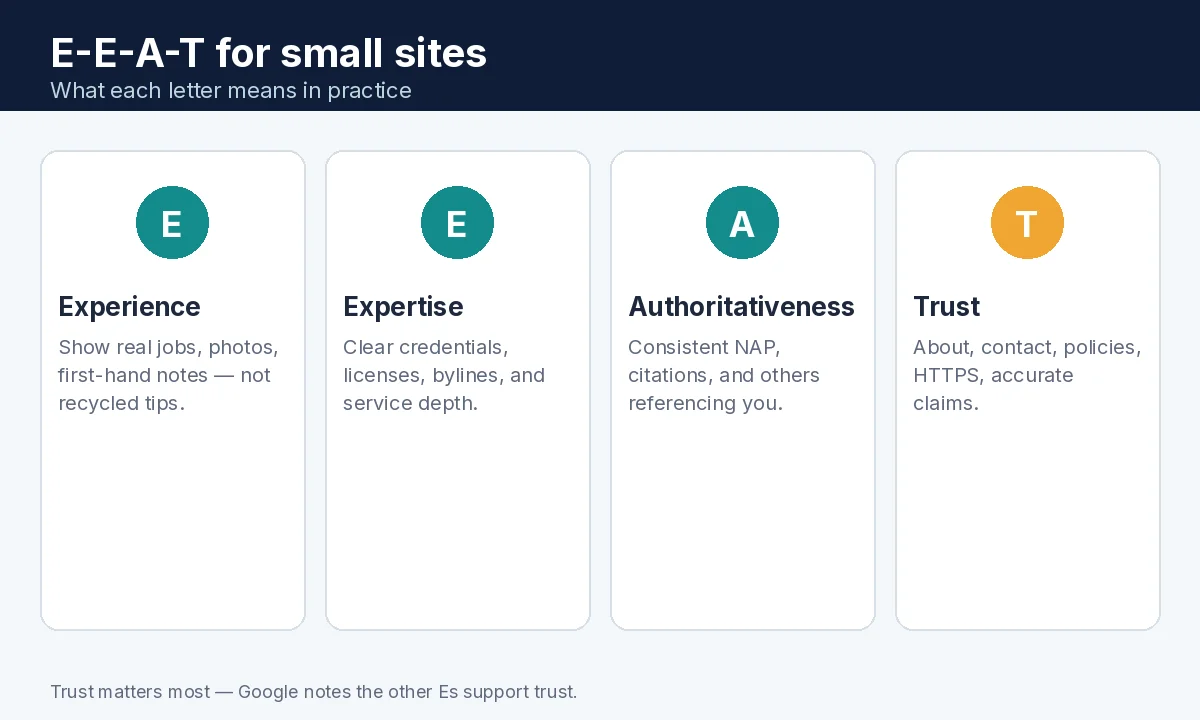
- Experience: Evidence you used the product, did the job, visited the place, or served the customer type you describe.
- Expertise: Skill and knowledge appropriate to the topic — licenses for trades, clinical credentials for clinics, deep process know-how for specialized services.
- Authoritativeness: Recognition as a go-to source — consistent identity, citations, and content others would trust to reference.
- Trust: Accuracy, honesty, transparency, secure site, and claims that match reality. Google states trust is the most important of these aspects.
Search quality raters use E-E-A-T concepts to evaluate whether algorithms surface helpful results. Raters do not rank your site directly — but reading the rater concepts helps you self-assess. Automated systems use many factors that correlate with good E-E-A-T; there is no “E-E-A-T plugin” to install.
Who, How, and Why — Google’s self-check
Search Central asks creators to be clear about:
- Who created the content — bylines, bios, organization identity.
- How it was created — first-hand work, testing method, tools, editorial process (including when AI assisted — be honest).
- Why it exists — primarily to help people, not to manipulate rankings.
If a stranger cannot tell who runs your HVAC company or who wrote your “best furnace” guide, fix that before you buy another backlink package.
The small-business E-E-A-T checklist (do these)
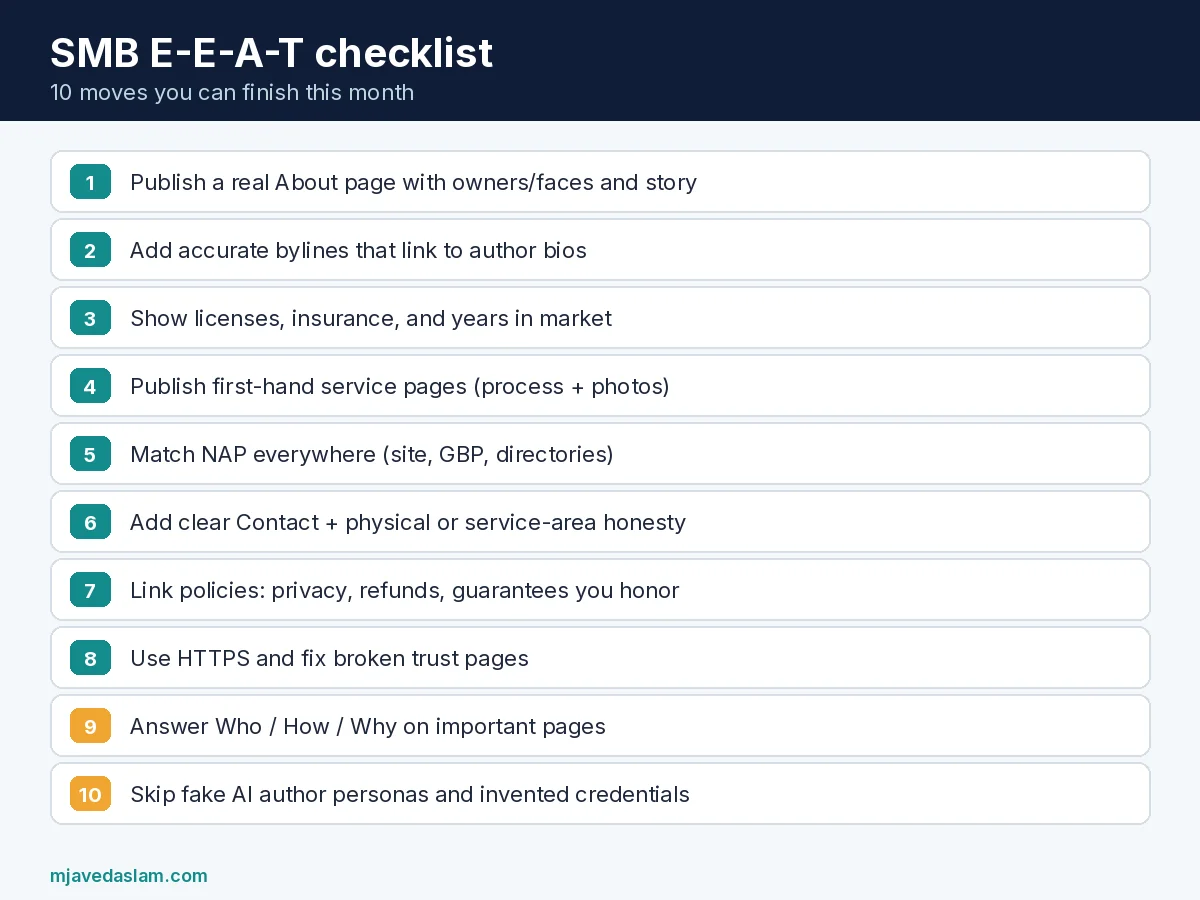
1) About page that could only be yours
Owners’ names, photo (optional but helpful), founding story, cities served, insurance/license callouts, and a contact path. Empty “We are passionate about excellence” pages fail the Who test.
2) Honest authorship
Blog posts and guides should show a real byline linking to a bio with relevant background. Google explicitly warns against fabricated creator profiles (AI headshots, made-up names, false credentials).
3) First-hand service pages
Each core service gets its own page with process, timelines, what customers prepare, and original photos — not spun city-page clones. That also helps AI features and classic Search find the right URL — get cited in AI Overviews, SEO services.
4) Proof of experience in the main content
Before/after galleries, job-site notes, “what surprised us on this install,” tool lists, and checklists from real days in the field beat generic “10 tips” posts.
5) Credentials and policies in plain view
License numbers where lawful to display, bonded/insured statements you can prove, warranty terms, refund/cancellation rules, privacy policy. Trust rises when promises are specific and kept.
6) Consistent business identity
Same name, address policy, phone, and hours on the site and Google Business Profile. Finish claim/verify and categories properly — claim GBP, primary category, local SEO.
7) Contact that works
Phone, form, or chat you actually answer. A Contact page with a dead form destroys Trust faster than a missing schema type.
8) Structured data that matches visible content
LocalBusiness / Organization markup should reflect what humans see — not inflated ratings or fake employee lists — LocalBusiness schema.
9) Page experience basics
Fast mobile pages, readable type, working buttons. Helpful content trapped behind a broken theme still fails users — Core Web Vitals on WordPress.
10) YMYL caution
Topics that can affect health, financial stability, or safety need higher accuracy and clearer sourcing. If you are not qualified to advise, say what you do and send readers to licensed professionals.
What you can skip (budget reality)
- National PR campaigns and celebrity endorsements.
- Buying fake reviews or inventing “Dr.” titles.
- Thin “locations” pages for cities you do not serve.
- Auto-generated author farms.
- Obsessing over one metric (a DA score, a single backlink) while About/Contact stay empty.
E-E-A-T is cumulative. A plumber with ten years of dated job photos and a clear About page often out-trusts a prettier site with stock images and no owner name.
How this ties to AI features (without cannibalizing those posts)
Google’s AI features guidance still starts with helpful, reliable, people-first pages that are eligible in Search. Strong E-E-A-T signals on your site support that foundation; they are not a separate “AI Overviews hack.” For mechanics of Overviews vs snippets or AI Mode definitions, use those dedicated articles — AI Overviews vs featured snippets, what is Google AI Mode.
On WordPress, keep technical hygiene so trust pages stay indexable: sitemaps that include the right content types — Yoast XML sitemap settings — and FAQ markup only where FAQs are visible — FAQ schema.
Quarterly habit: pick your top five money pages and answer Who/How/Why in one pass. Update bios when staff change. Replace any stock hero that contradicts your real storefront. Re-read claims on pricing and guarantees after every offer change.
If you publish with freelancers or AI drafts, require a human editor with topic experience to add first-hand detail and remove invented statistics. Disclose significant AI assistance when it would surprise readers. Fabricated expertise is a Trust bomb — Search Central calls that out explicitly.
Local businesses should treat Google Business Profile as part of the same trust system: accurate hours, photos, review replies, and categories reinforce the site’s story — Google Business Profile, review templates.
Owner checklist for this week: photograph one real job, write five sentences about what went wrong and how you fixed it, put that on the matching service page, and link the author’s bio. That single loop — experience documented, expertise named, page updated — compounds faster than another generic “ultimate guide.”
When you hire writers, give them access to SOPs, invoices patterns (redacted), and technician notes so the draft cannot drift into stock advice. Your editor’s job is to delete anything you would not say to a customer in the driveway. That editorial standard is E-E-A-T in daily operations, not a slide deck.
FAQ: E-E-A-T for small business websites
Is E-E-A-T a Google ranking factor?
Google says E-E-A-T itself is not a specific ranking factor. Systems use many signals that identify helpful, reliable content aligning with strong E-E-A-T — and trust is emphasized as most important.
What should a small business About page include for E-E-A-T?
Who runs the business, where you serve, how long you’ve operated, credentials/insurance you can prove, and how to contact a human. Specific beats vague brand poetry.
Do I need an author bio on every blog post?
Google encourages accurate authorship information such as bylines that lead to further background. For YMYL topics, clear expertise is especially important. Never invent authors.
Can AI-written content have E-E-A-T?
Content is judged on helpfulness and reliability. Be honest about how content was created; add first-hand experience; do not fabricate expert personas. People-first purpose still matters.
What’s the fastest E-E-A-T win for a local service site?
Usually: a concrete About page, matching NAP/GBP details, original job photos on service pages, and working contact paths — before any exotic link tactics.
Does schema markup create E-E-A-T?
Schema helps machines understand entities when it matches visible content. It does not replace real credentials, reviews, or accurate pages.