
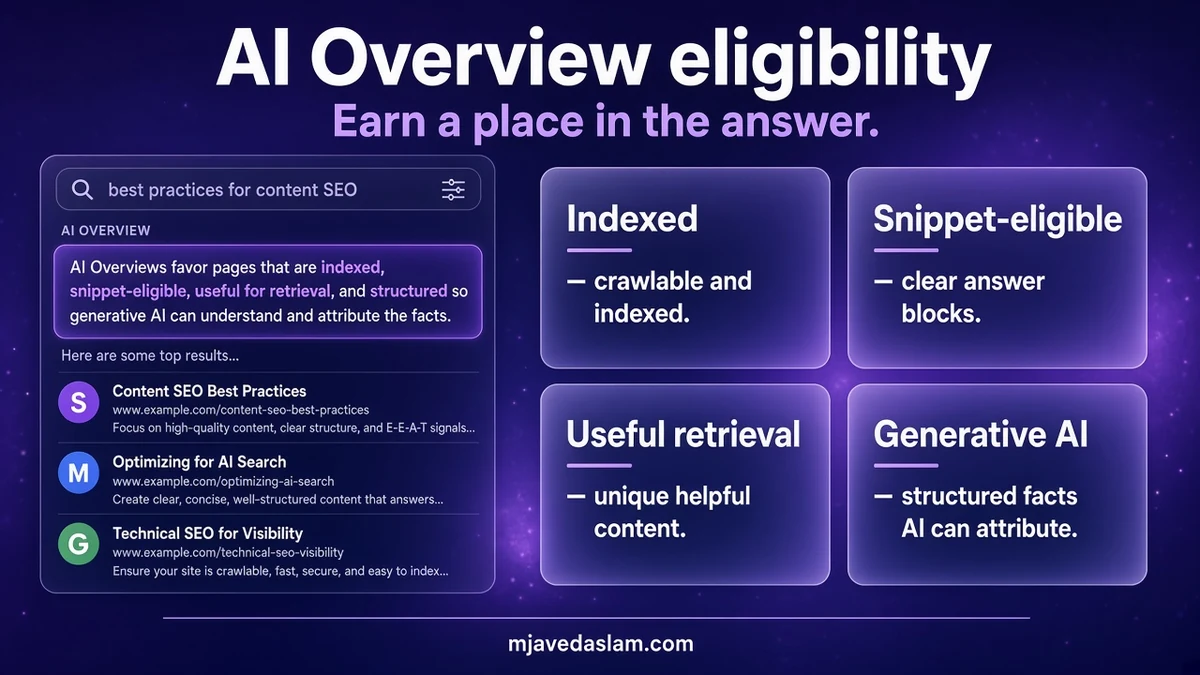
There is no secret “AI citation markup.” If you want to know how to get cited in google ai overviews, Google’s own guidance is blunt: meet normal Search technical requirements, stay eligible for snippets, keep Search generative AI inclusion on, and publish unique, people-first pages that core ranking systems can retrieve — including via query fan-out.
This guide is the practical checklist I give small sites. It complements (and does not rewrite) how to show up in AI Overviews and the comparison in AI Overviews vs featured snippets. No fabricated CTR promises — just what Search Central documents and what you can actually ship this week.
How to get cited in Google AI Overviews (eligibility first)
To appear as a supporting link in AI Overviews or AI Mode, Google says a page must be:
- Indexed in Google Search.
- Eligible to show with a snippet (meet Search technical requirements).
- Covered by your property’s Search generative AI inclusion setting in Search Console (default is include).
There are no additional technical requirements, no special AI text files, and no special schema.org types required for these features. Structured data still helps classic rich results — keep using it where it matches visible content — but it is not an AI Overviews ticket.
Indexing and serving are never guaranteed even when you “do everything right.” Treat citation as a byproduct of being a useful retrieved source, not a badge you purchase.
How Google pulls supporting pages (plain English)
Search Central describes generative AI features as rooted in core ranking and quality systems:
- Retrieval / grounding (RAG-style): relevant, up-to-date pages are retrieved from the index to support the response, with clickable links.
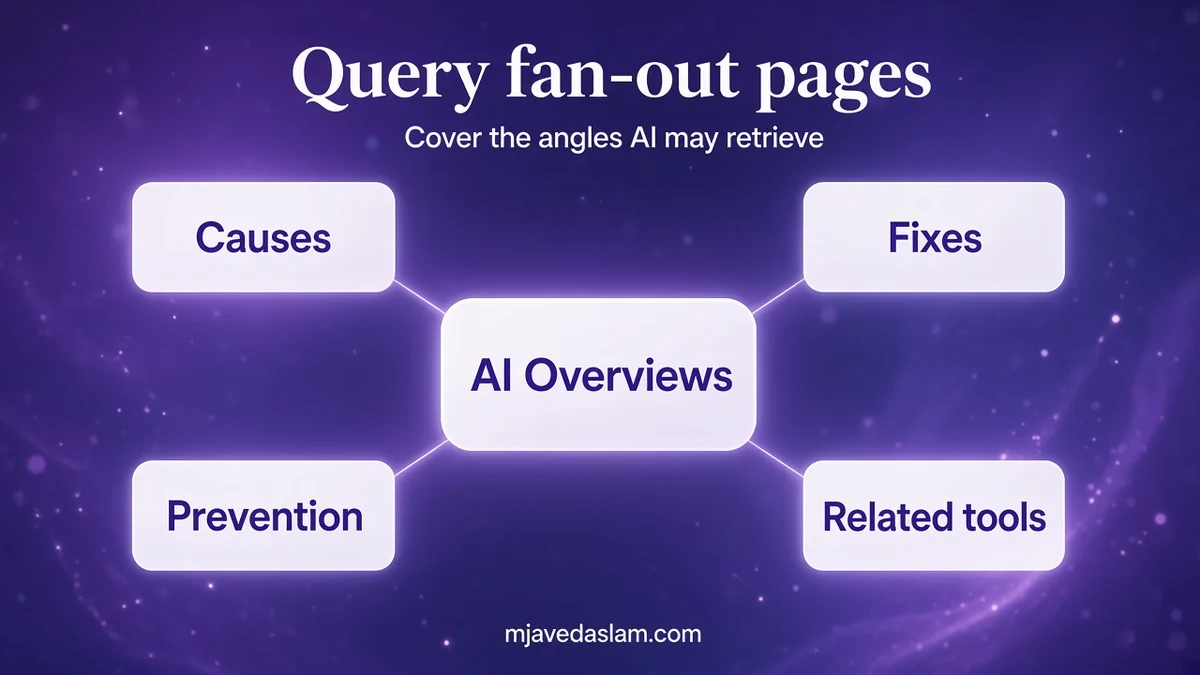
- Query fan-out: related sub-searches run so the system can gather more supporting results (Google’s lawn-weeds example fans into herbicides, non-chemical removal, prevention, and similar).
AI Overviews and AI Mode can use different models/techniques, so links differ. Overviews appear when systems decide they add value beyond classic results — they often don’t trigger at all.
Implication for small sites: build clear pages for real sub-questions customers ask (pricing caveats, process steps, eligibility, local logistics). Fan-out creates more “slots” for specific pages — stuffing one mega-page with every variation to manipulate responses violates spam/abuse expectations Google warns about.
Content that earns citations (non-commodity)
Google’s generative AI optimization guide says unique, compelling, useful content will likely influence presence more than other tips. Attributes they call out include:
- Unique point of view — first-hand experience beats recycled summaries.
- Non-commodity depth — not another generic “7 tips” list anyone (or any model) could produce.
- Helpful, reliable, people-first writing aligned with existing helpful-content guidance.
For a local service business, that looks like: your diagnostic checklist, photos of real jobs (with permission), honest timelines, what you won’t do, and city-specific logistics — not paraphrasing national blogs.
For a niche B2B site: original data, worked examples, failure modes, and decision frameworks your buyers actually use.
Technical and on-page checklist (still “just SEO”)
From Google’s AI features + optimization docs, prioritize:
- Allow crawling (robots.txt / CDN / host not blocking Googlebot).
- Make pages findable with internal links.
- Deliver a solid page experience (mobile layout, reasonable latency, main content easy to spot).
- Keep important answers in text (not only images or locked PDFs).
- Support text with high-quality images/video when useful (normal image/video SEO applies).
- If you use structured data, make sure it matches visible text.
- Keep Merchant Center and Business Profile details current where relevant — local/product info can surface in AI responses and classic Search.
- Reduce pointless duplicate URLs that waste crawl budget.
Verify the site in Search Console. Confirm Settings → Search generative AI is set to include your links and content (Help notes worldwide rollout of this control; excluding means you won’t get impressions/traffic from those generative features).
A small-site “citation sprint” (one week)
- Day 1: Pick 5 money questions customers ask that deserve their own URL (not homepage blurbs).
- Day 2–3: Write first-hand answers with steps, caveats, and original photos.
- Day 4: Internal-link them from services and FAQ hubs; submit URLs in Search Console if needed.
- Day 5: Align NAP/hours/services on site + Business Profile.
- Day 6: Fix mobile UX on those URLs (tap targets, speed, form).
- Day 7: Note baseline in the Generative AI performance report (when available for your property).
Pair this with classic local work — categories, description, and vertical checklists like local SEO for dentists — so retrieved pages and Maps info don’t conflict.
Local and ecommerce details still matter
Google notes that generative AI responses can include product and local-business information where appropriate. Keeping Merchant Center feeds and Google Business Profile data accurate helps visibility in AI responses and classic Search alike. That means hours, services, products, and descriptions should match the pages you’re hoping get retrieved.
If your “citation” goal is really “get the phone to ring,” a beautiful blog post that contradicts your Maps hours will train both users and systems to distrust you. Fix the entity layer (profile + NAP + service pages) before publishing another roundup of AI SEO tips. Consistency beats another thin explainer every single time for small sites.
For WordPress sites, avoid stacking three different LocalBusiness JSON-LD plugins on top of Yoast — duplicate markup confuses rich results and doesn’t unlock AI Overview links. See LocalBusiness schema without duplicates.
Myths and “GEO/AEO” hacks to skip
- “Special AI schema unlocks citations.” Google: no special schema required for generative AI features.
- “Write an llms.txt and you’re set.” Google: you don’t need new machine-readable AI files for these features.
- “AEO/GEO replaces SEO.” Google frames optimizing for generative AI search as still SEO; be cautious with third-party hacks.
- “Third-party tools show Google’s internal AI rank.” Search Central warns no third-party tool has access to internal ranking or AI systems.
- “Mass-produce every fan-out variant.” Creating pages primarily to manipulate rankings or generative responses is the wrong goal.
Measure with Search Console’s Generative AI performance report for impressions and which pages appear — not vanity “citation score” SaaS dashboards.
When you review competitors who appear as supporting links, study the job their page does — original photos, specific numbers they earned the right to publish, clear definitions — not their adjective density. Copying their outline without your experience recreates commodity content Google’s guide tells you to avoid.
FAQ: getting cited in AI Overviews
How do I get cited in Google AI Overviews?
Be indexed and snippet-eligible, keep generative AI inclusion on, and publish unique helpful pages that ranking systems can retrieve — including for fan-out sub-questions. No special AI markup is required.
Is there a special schema for AI Overview citations?
No. Google says there’s no special schema.org markup required for generative AI features. Use structured data for rich-result eligibility where it matches visible content.
Do AI Overviews use the same links as AI Mode?
Not necessarily. Google notes they may use different models and techniques, so supporting links can differ.
Can I opt out of AI Overviews but stay in classic Search?
Search Console’s Search generative AI control can exclude your links/content from generative AI features. Help states that control isn’t used as a ranking signal for other parts of Search.
Does FAQ schema guarantee an AI Overview citation?
No. FAQ markup is unrelated as a guarantee — and FAQ rich results themselves changed in 2026 (see FAQ schema in WordPress). Focus on useful pages, not a single schema trick.
What’s the fastest win for a small local site?
One excellent first-hand service page per core job + accurate Business Profile + crawlable text answers to the follow-up questions customers actually ask.
Need a broader SEO pass beyond AI features? See SEO services and all services.