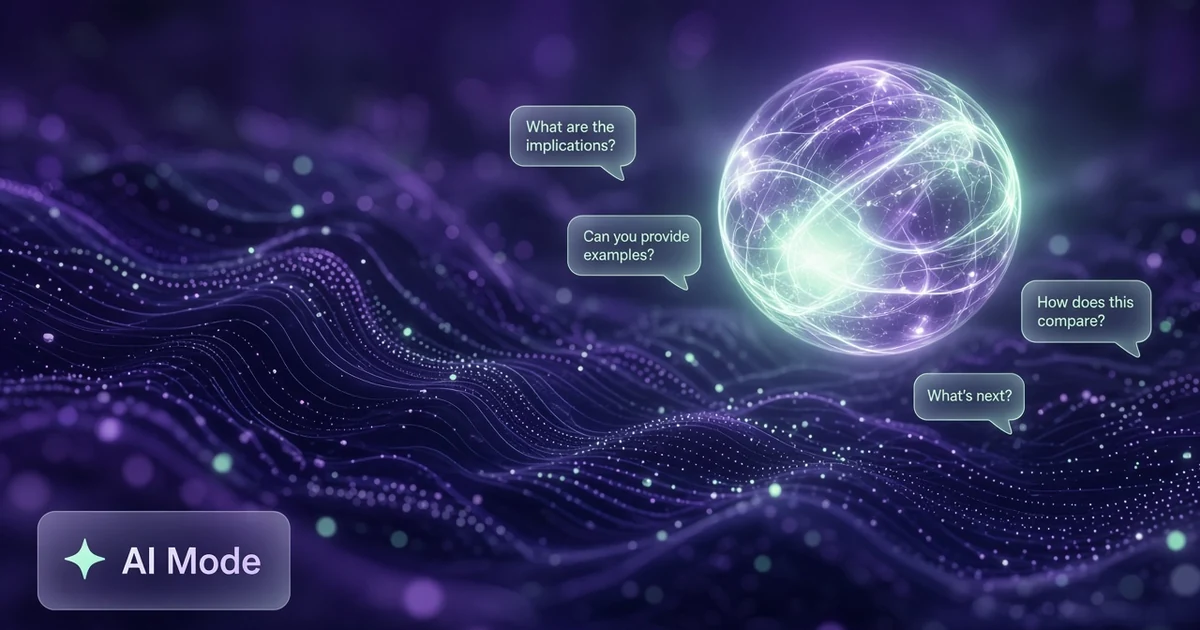
What is Google AI Mode? It’s Google’s deeper, conversational AI search experience inside Search — built for complex, multi-part questions, comparisons, and follow-ups — with links out to the web. It expands what AI Overviews can do; it is not the same as the Gemini app, and it is not a featured snippet.
This article stays definitional on purpose. For Overviews vs snippets, see AI Overviews vs featured snippets. For citation/SEO tactics, see get cited in AI Overviews and show up in AI Overviews. Here we clarify what AI Mode is, how it differs from Overviews, and what that means for businesses.
What is Google AI Mode? (plain definition)
Per Google Search Help, AI Mode is Google’s most powerful AI search experience: ask anything, get an AI-powered response, then go deeper with follow-up questions and helpful web links. It uses advanced reasoning and a query fan-out technique — dividing your question into subtopics and searching them concurrently — then synthesizes an answer grounded in Search’s understanding of the web (plus systems like Knowledge Graph and shopping data where relevant).
If confidence in an AI response isn’t high enough, AI Mode may fall back to a set of web links instead of a generated answer. Google also notes it won’t always get things right — treat outputs like any early-stage AI feature.
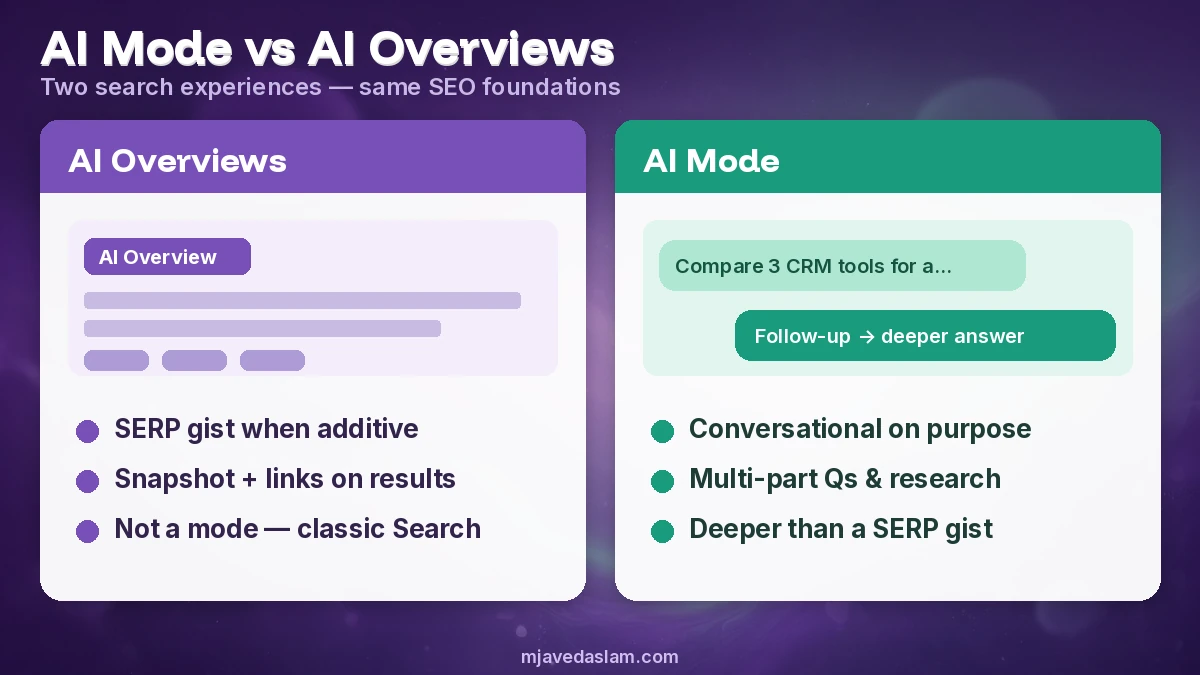
AI Mode vs AI Overviews (for businesses)
| Feature | AI Overviews | AI Mode |
|---|---|---|
| Where it lives | Often on the classic results page when Google decides it’s additive | A dedicated conversational Search mode / experience |
| Best for | Quick gist of a topic with jumping-off links | Complex exploration, comparisons, multi-part questions, follow-ups |
| Triggering | Shown only when systems judge it helpful; often doesn’t trigger | Designed as an AI-first mode you enter (and can jump into from Overviews on mobile in rolled-out markets) |
| Models / techniques | May differ from AI Mode | May use different models/techniques; link sets can differ |
| Site eligibility | Indexed + snippet-eligible pages; normal SEO | Same foundational requirements — no special “AI Mode markup” |
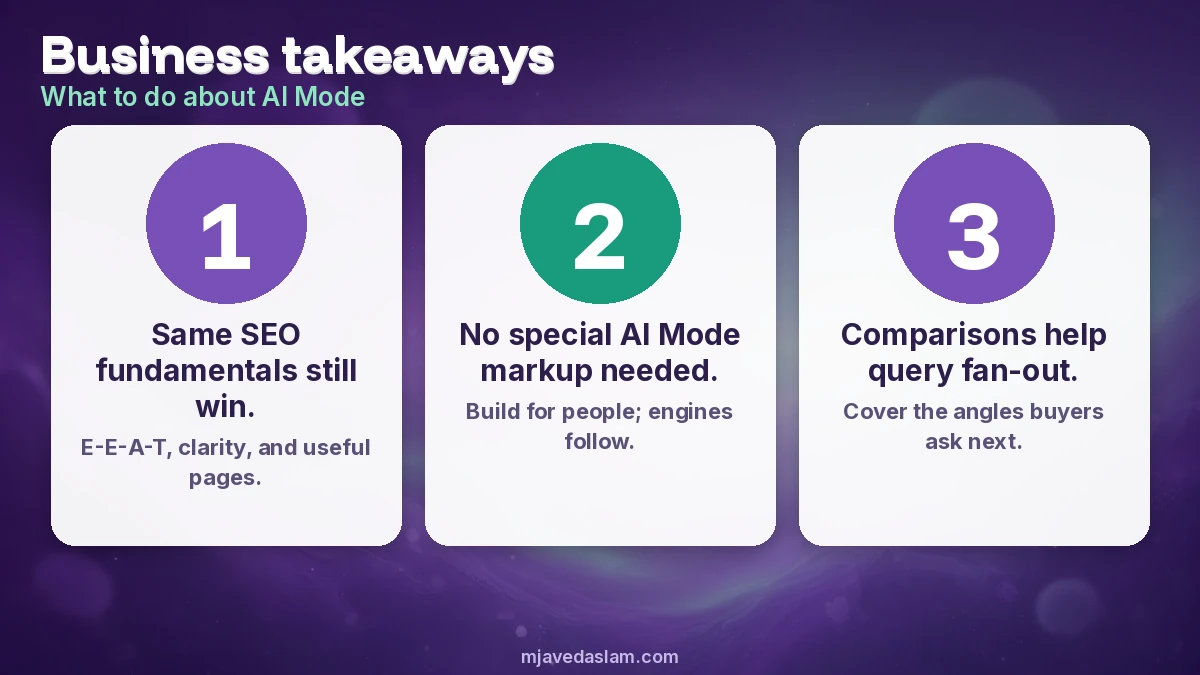
Google Search Central: AI Mode and AI Overviews may use different models and techniques, so responses and supporting links can vary. Both may use query fan-out. There are no additional technical requirements beyond normal Search eligibility to appear as a supporting link.
AI Mode vs Gemini app vs classic Search
- AI Mode — Inside Google Search; grounded in Search systems and web links for exploration.
- Gemini app / gemini.google.com — Separate Gemini product experience (chat, apps, etc.), not the same UI as Search’s AI Mode.
- Classic blue links — Still core Search; AI features sit alongside, not as a full replacement for every query.
When someone says “I saw it in Google AI,” ask whether they mean an Overview on the SERP, AI Mode conversation, or Gemini — the traffic implications differ.
A short history (so 2024–2026 posts make sense)
- March 2025: Google introduced AI Mode as a Labs experiment while expanding AI Overviews (Gemini upgrades, wider access).
- Through 2025–2026: Broader availability and Help documentation for using AI Mode in Search; ongoing UX and model updates.
- January 2026: Google blogged Gemini upgrades for Overviews globally and easier jumps from AI Overviews into AI Mode conversations on mobile.
- 2026: Continued updates on how Overviews and AI Mode surface links and help people explore the web.
Availability still depends on country/language and product rollouts — check Google’s current AI Mode Help for supported regions rather than assuming every market matches the US.
What this means for small businesses (without cannibalizing the SEO guides)
- Same fundamentals: Indexable, snippet-eligible, helpful pages. Google says no special AI-only optimization is required.
- Comparisons & nuance win in AI Mode: Pages that clearly compare options, explain tradeoffs, and answer multi-part questions are useful when fan-out retrieves supporting links.
- Local still matters: Accurate Business Profiles and local pages help when AI experiences pull real-world business info — keep GBP healthy (GBP help).
- Measure carefully: Traffic from AI surfaces can look different in analytics; watch branded search and assisted conversions, not only last-click organic.
- Don’t buy “AI Mode ranking packages”: There is no official paid placement inside AI Mode answers.
Deep tactics live on the Overviews citation guides linked above. This page’s job is vocabulary and product clarity so you don’t optimize for the wrong feature.
How people open AI Mode
UI labels change. In general, users access AI Mode from Search (and Labs experiments where offered), and in rolled-out experiences can continue from an AI Overview into an AI Mode conversation. For current buttons and settings, follow Google Search Help’s AI Mode article — settings for Search services were being updated as of Google’s own Help notes.
For agencies writing client decks: put AI Mode in the “Search product literacy” slide, not the “secret ranking factor” slide. Clients who understand Overviews vs Mode ask better questions about content briefs (comparison tables, FAQ depth, first-hand data) instead of demanding invisible markup.
Publishers should watch how links are presented inside AI experiences as Google iterates — blog posts in 2026 emphasize helping people explore websites from AI responses. Your job remains producing pages worth clicking, with clear titles and scannable answers that survive being summarized.
Regulated industries: AI Mode answers may paraphrase your content. Keep on-site disclaimers accurate; don’t assume an AI summary preserves every caveat. Where claims must be precise (medical, legal, financial), make the canonical wording unmistakable on the page you want cited.
Finally, train support teams: customers may arrive mid-comparison after an AI Mode session. Landing pages that restate the comparison axes (price, fit, service area, warranties) reduce bounce from conversational searchers who already have context.
Query fan-out is why thin doorway pages struggle: related subtopics need real coverage. If your “best HVAC in [city]” page is three paragraphs of fluff, fan-out may prefer a manufacturer guide, a standards page, or a competitor with clearer comparisons. Depth beats keyword stuffing when the system is searching multiple angles at once.
Shopping and product questions may pull shopping graph data alongside web links. Local service businesses still win with proof (reviews, photos, clear services) more than with speculative “AI Mode SEO” plugins.
When Google updates Search services settings, screenshots in old tutorials go stale overnight. Prefer official Help for how to open AI Mode or Labs experiments; this article focuses on concepts that survive UI renames.
Pair AI literacy with Core Web Vitals and classic SEO — speed and clarity still affect the pages people land on after an AI citation. See fix Core Web Vitals on WordPress if Search Console shows Failed assessments.
Bookmark Search Central’s AI features guide — it’s the site-owner source of truth when blogs overclaim.
FAQ: Google AI Mode
What is Google AI Mode called?
Google names it AI Mode in Search (sometimes discussed alongside AI Overviews as generative AI Search features). It is distinct from the Gemini consumer app branding.
Is AI Mode the same as AI Overviews?
No. Overviews are often a SERP snapshot when additive; AI Mode is a deeper conversational Search experience for complex questions and follow-ups.
Is AI Mode the same as Gemini?
AI Mode uses Gemini-family models inside Search, but “Gemini” also names separate apps/products. Don’t conflate the Search mode with the Gemini app.
Do I need special schema to show up in AI Mode?
Google Search Central says no additional requirements beyond normal indexing and snippet eligibility. Structured data should match visible content when you use it.
Can AI Mode be wrong?
Yes. Google states it doesn’t always get it right and may show web links instead when confidence is low. Encourage users to check linked sources.
What should businesses do first?
Ship clear, unique pages; keep technical SEO healthy; maintain accurate local info — then use the Overviews-focused guides for citation tactics.
For broader SEO help as Search evolves, see SEO services.