Yoast SEO focus keyphrase best practices means picking one clear phrase people actually search, placing it where Yoast checks (title, intro, H2s, slug, meta, image alt) without stuffing, and treating the traffic lights as a checklist — not a grade that replaces useful writing.
This is a WordPress/Yoast craft guide for small-business sites. It is not the XML sitemap settings article, robots.txt guide, breadcrumbs tutorial, or FAQ schema walkthrough.
Technical SEO help: SEO services.
Yoast SEO focus keyphrase best practices — quick answer
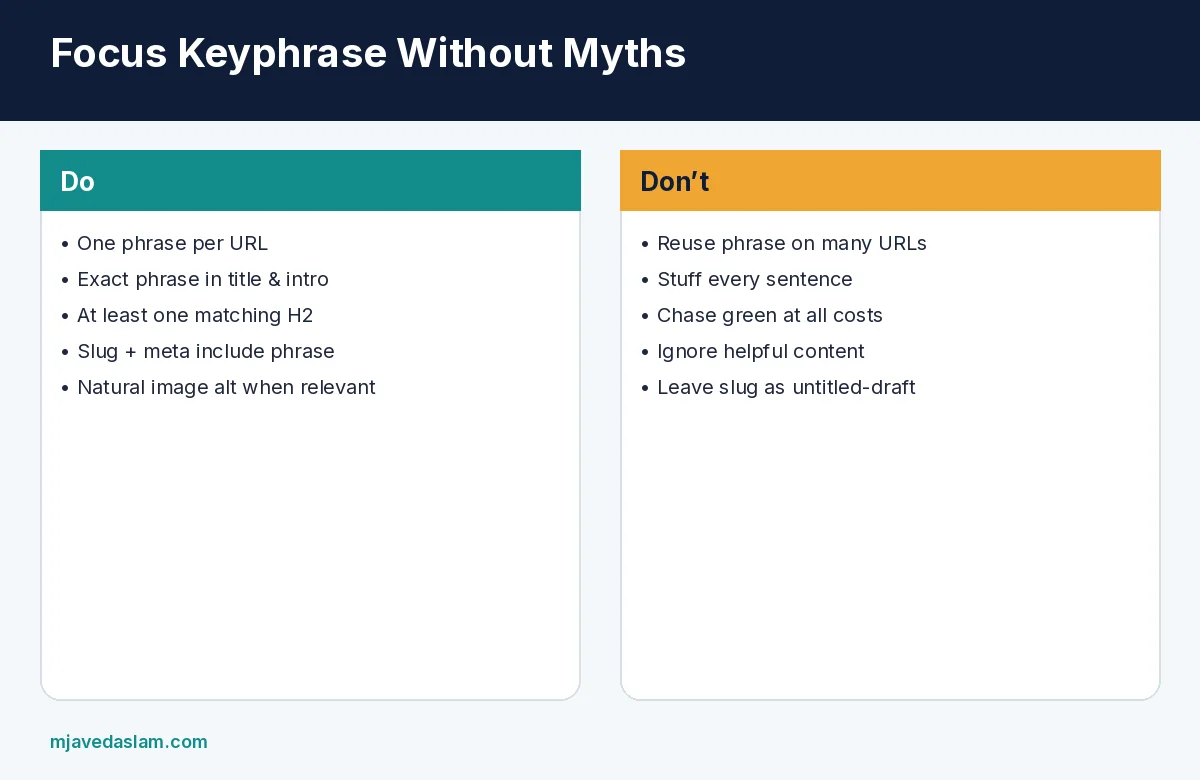
- Choose one focus keyphrase per URL — the primary topic, not five synonyms crammed into one field.
- Use that exact phrase (or Yoast’s recognized inflection where the analysis allows) in the SEO title, first paragraph, at least one H2, slug, meta description, and an image alt when natural.
- Keep the SEO title roughly in Yoast’s length guidance and end brand names cleanly (on this site we use “| Javed Aslam”).
- Do not reuse the same focus keyphrase on multiple published URLs — Yoast warns for a reason: you cannibalize yourself.
- Green lights help; a useful answer for humans ranks the intent. Fix red items that block clarity; ignore orange noise that would make the copy worse.
Yoast’s own documentation covers how to pick a focus keyphrase, why to use it once, and what the SEO analysis evaluates. None of that replaces Google’s helpful-content guidance.
How to choose the phrase (without worshipping volume)
Prefer phrases that match the page’s job:
- A service page → “emergency plumber [city]” only if that is truly the page topic.
- A how-to → the task language (“claim google business profile”).
- A comparison → the vs language users type.
Skip vanity phrases you will not support with content. If two pages need related topics, differentiate the keyphrases (e.g., sitemap settings vs focus keyphrase vs breadcrumbs) instead of cloning. Internal linking then connects the cluster: this page ↔ Yoast XML sitemap settings, robots.txt with Yoast, Yoast breadcrumbs.
Where Yoast looks (and how to stay natural)
Typical SEO analysis checks include keyphrase in:
- SEO title / keyphrase in title
- Introduction
- Subheadings
- Slug
- Meta description
- Image alt attributes
- Density / distribution (enough signal, not spam)
Write the draft for the reader first. Then run Yoast and fix gaps: add the phrase to an H2 that already fits, tighten the slug, rewrite the meta so the phrase appears once without sounding robotic. Function words and length guidance are documented by Yoast — use them as guardrails.
Related on-page helpers: FAQ schema on WordPress when FAQs are visible on the page, and Core Web Vitals so the content is usable: fix Core Web Vitals.
One keyphrase, one URL
Yoast’s “use your focus keyphrase only once” guidance exists because two posts fighting for the same phrase split clicks and confuse internal linking. If you outgrow an old post, consolidate or retarget the older URL’s keyphrase — do not publish a near-duplicate “updated 2026” twin with the same focus.
Cornerstone and internal link suggestions in Yoast Premium are optional aids; free users can still map clusters in a spreadsheet.
Traffic lights: use, do not obey blindly
- Red: usually fix — missing phrase in intro/title, empty meta, tiny content for a big claim.
- Orange: judgment — density warnings on short pages, outbound link suggestions that do not fit, “exact match in H1” when your theme already prints the title.
- Green: nice confirmation, not a ranking certificate.
Readability analysis (sentence length, transition words, passive voice) is separate from the focus keyphrase. Improve clarity for your audience; do not wreck voice to force a green bullet.
Common Yoast focus keyphrase mistakes
- Stuffing the phrase into every sentence until density screams.
- Choosing a keyphrase the page never actually answers.
- Reusing one phrase across five thin city pages.
- Writing meta descriptions for Yoast’s pixel bar while omitting the phrase users need to see in the SERP.
- Ignoring the slug (still “untitled-draft-3”) after the title is perfect.
- Treating green lights as permission to skip helpful content and E-E-A-T basics: E-E-A-T checklist.
Workflow I use on WordPress
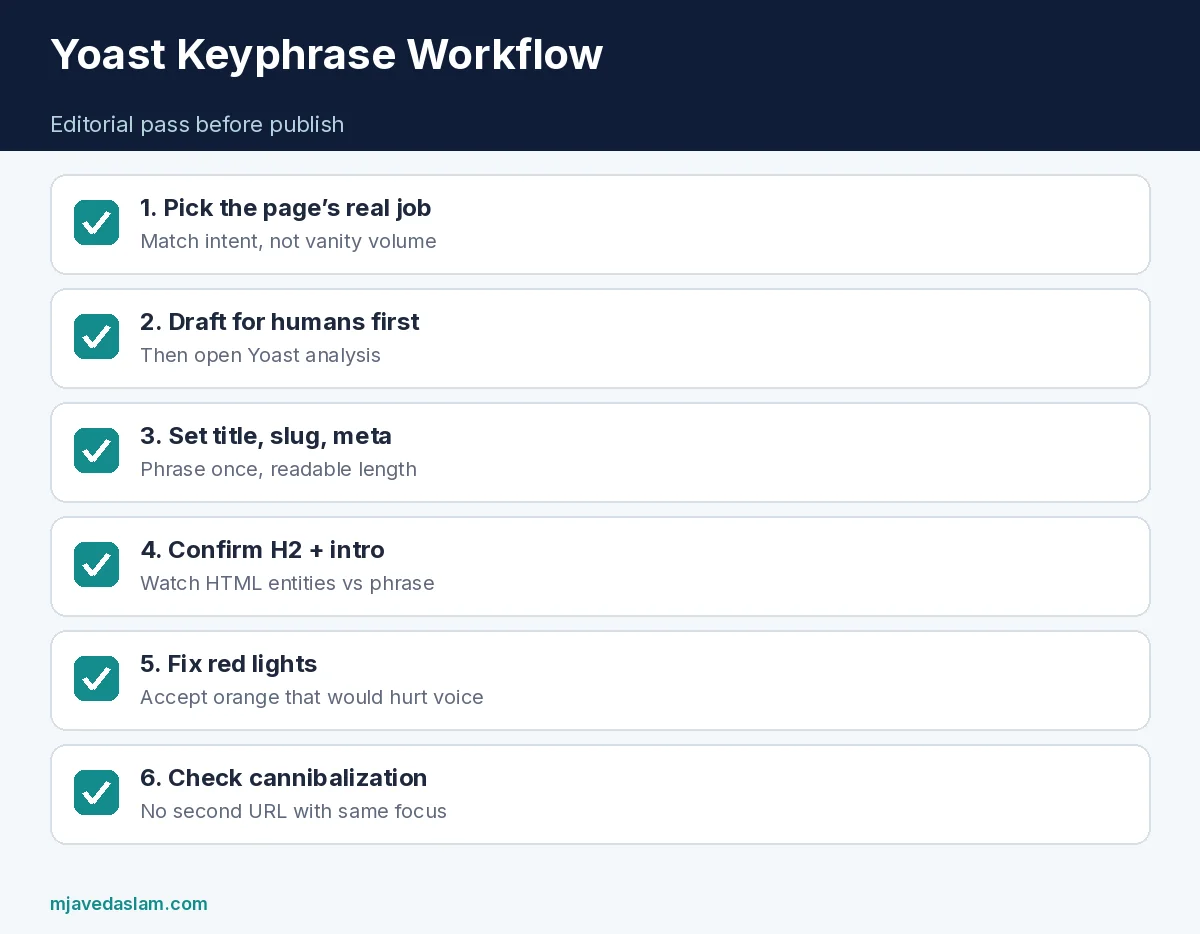
- Outline H2s that match search intent.
- Draft the full answer.
- Set focus keyphrase + synonym fields if you use them carefully.
- Edit SEO title, slug, meta.
- Ensure one H2 contains the exact phrase (watch HTML entities — “Q&A” vs “q and a”).
- Add alts on meaningful images.
- Resolve red analysis items; accept remaining orange with a note.
- Preview social/SERP snippets; publish; submit/monitor via Search Console as usual — sitemaps: see the Yoast sitemap guide.
When you redesign a theme, re-check that the SEO title still renders in the SERP preview and that your H1 (often the post title) still aligns with the focus keyphrase strategy. Theme changes silently break assumptions Yoast cannot see.
Multilingual sites should set focus keyphrases per language version, not reuse an English phrase on a translated URL. Each language page needs its own intent match.
For affiliate or comparison posts, the keyphrase should match the decision query (“google ads vs meta ads for local business”) while the copy stays independent and non-deceptive. Yoast green lights do not excuse thin affiliate spam.
If you use the related keyphrases / synonyms fields, keep them honest variants — not a laundry list of every city you hope to rank for on one URL. Cities belong on dedicated, unique pages or not at all.
Export or note keyphrases in a content inventory spreadsheet so writers do not accidentally reuse one. Yoast’s warning helps after the fact; a planning sheet prevents the collision.
Remember: Search Console queries may show variants you did not set as the focus. That is normal. Expand content to cover related questions with new H2s; do not forever chase every variant into the same focus field.
Finally, pair on-page keyphrase hygiene with technical basics already covered on this site — sitemaps, robots.txt, breadcrumbs, and Core Web Vitals — so a well-optimized snippet lands on a page that loads and can be crawled.
Editors should treat the focus keyphrase like a product SKU for the URL: unique, intentional, and rarely changed after publish. If the business pivots, update the page content and keyphrase together — or redirect to a better URL.
Short cornerstone pages can still pass analysis if they answer the query completely. Padding to impress a word-count myth helps neither Yoast nor readers. Add FAQs or examples only when they are useful.
When Yoast flags outbound links, add citations to official docs (Google, Meta, Yoast) rather than random blogs. That habit also keeps your sources.md honest for editorial QA.
Preview the snippet on mobile widths: a truncated SEO title that cuts your keyphrase mid-word helps no one. Move the phrase earlier in the title if the brand suffix crowds it out.
FAQ: Yoast SEO focus keyphrase best practices
01Is the focus keyphrase a ranking factor?
The Yoast field itself is not a Google ranking factor. It is an editorial checklist so you place the topic phrase where on-page SEO traditionally matters.
02Exact match or close variants?
Prefer the exact phrase where Yoast checks it. Yoast may recognize some word forms; do not rely on creative paraphrases for every check.
03How many times should the phrase appear?
Enough to be clear in title, intro, a heading, and meta — not a fixed invented percentage. If density turns red from stuffing, cut repetitions.
04Should every page use Yoast Premium synonyms?
Optional. Synonyms help natural language when used honestly; they are not a substitute for unique content.
05What if two services share wording?
Differentiate keyphrases and intent (e.g., cost guide vs how-to setup). Link them; do not clone.
06Do green lights guarantee rankings?
No. They mean the plugin’s checks passed. Rankings still depend on relevance, competition, links, and helpful content.
Need WordPress SEO setup beyond the plugin lights? Start at SEO services or services overview.

✳Written by
Javed Aslam
Digital marketer, copywriter and SEO specialist. I help small businesses get found, read and chosen. More about me.