Local landing page SEO for service areas means building city or neighborhood pages that help real customers understand whether you serve them — with unique proof, honest coverage, and clear next steps — without spinning thin doorway pages that exist only to rank for “service + city” queries.
This guide is about compliant service-area pages on your site. It is not the Service schema tutorial alone, not the SAB Google Business Profile setup guide, and not the generic Map Pack checklist — though all three connect.
Hands-on local work: local SEO services.
Local landing page SEO for service areas — quick answer
- Create a page only where you have real capacity and something unique to say (projects, response times, permits, parking notes, crew based nearby).
- Lead with who you serve and how booking works; include NAP consistency with GBP; avoid keyword-stuffed titles.
- Differentiate each page: local proof, FAQs, photos from that area when you have them — not a find/replace city name.
- Link from a clean service-area hub and from relevant service pages; do not orphan fifty clones.
- Skip doorway patterns Google defines as spam: near-duplicate pages aimed at funneling users to identical content.
Google’s spam policies explicitly discuss doorway abuse. Helpful, people-first content guidance still applies. Local ranking on Maps remains relevance, distance, and prominence — website pages support relevance and prominence; they do not teleport your pin.
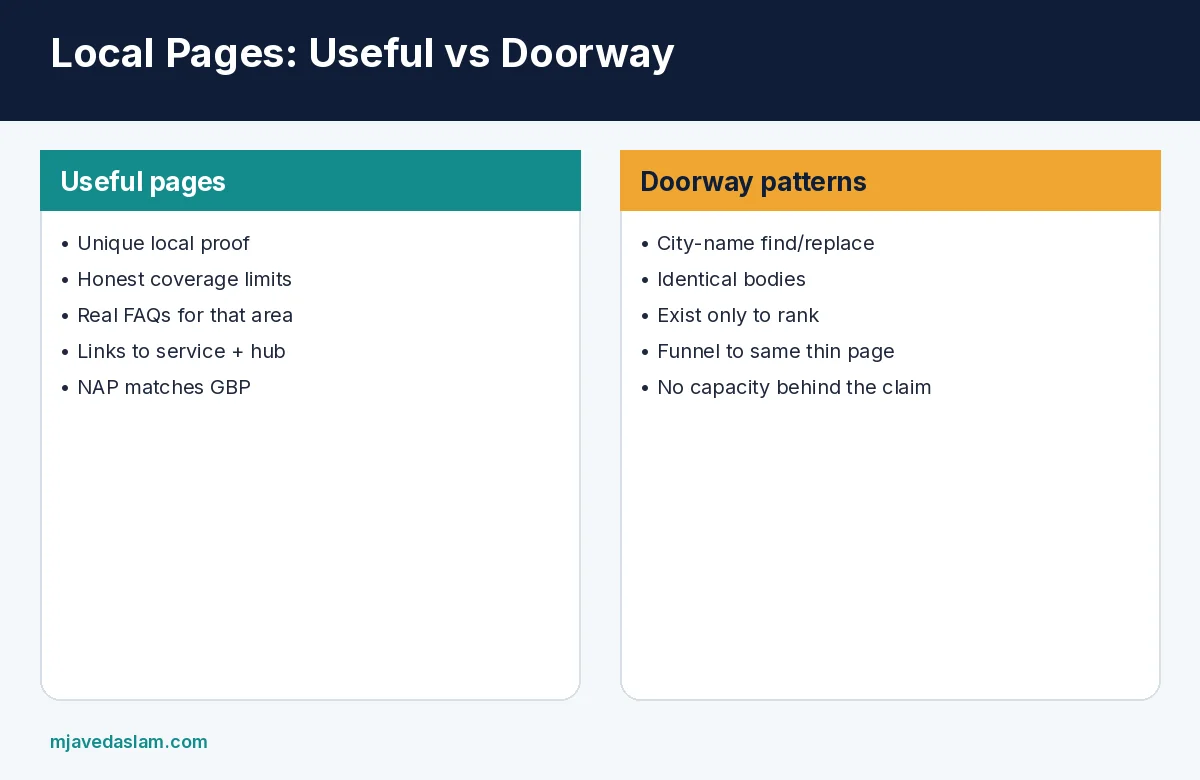
Doorway spam vs useful local pages
Doorway-style pages typically:
- Swap city names in an otherwise identical template.
- Exist mainly to rank, then send everyone to the same thin homepage.
- Offer no unique help for someone in that area.
Useful service-area pages typically:
- Explain coverage boundaries and travel/fees honestly.
- Show proof from that market (jobs, reviews mentioning the area, partner notes).
- Answer local FAQs (HOA rules you know, common housing stock, winter access).
- Match what GBP service areas and the footer NAP claim: NAP consistency checklist.
If you have no public office, configure GBP as a service-area business correctly — website pages should not invent a fake lobby: SAB on GBP.
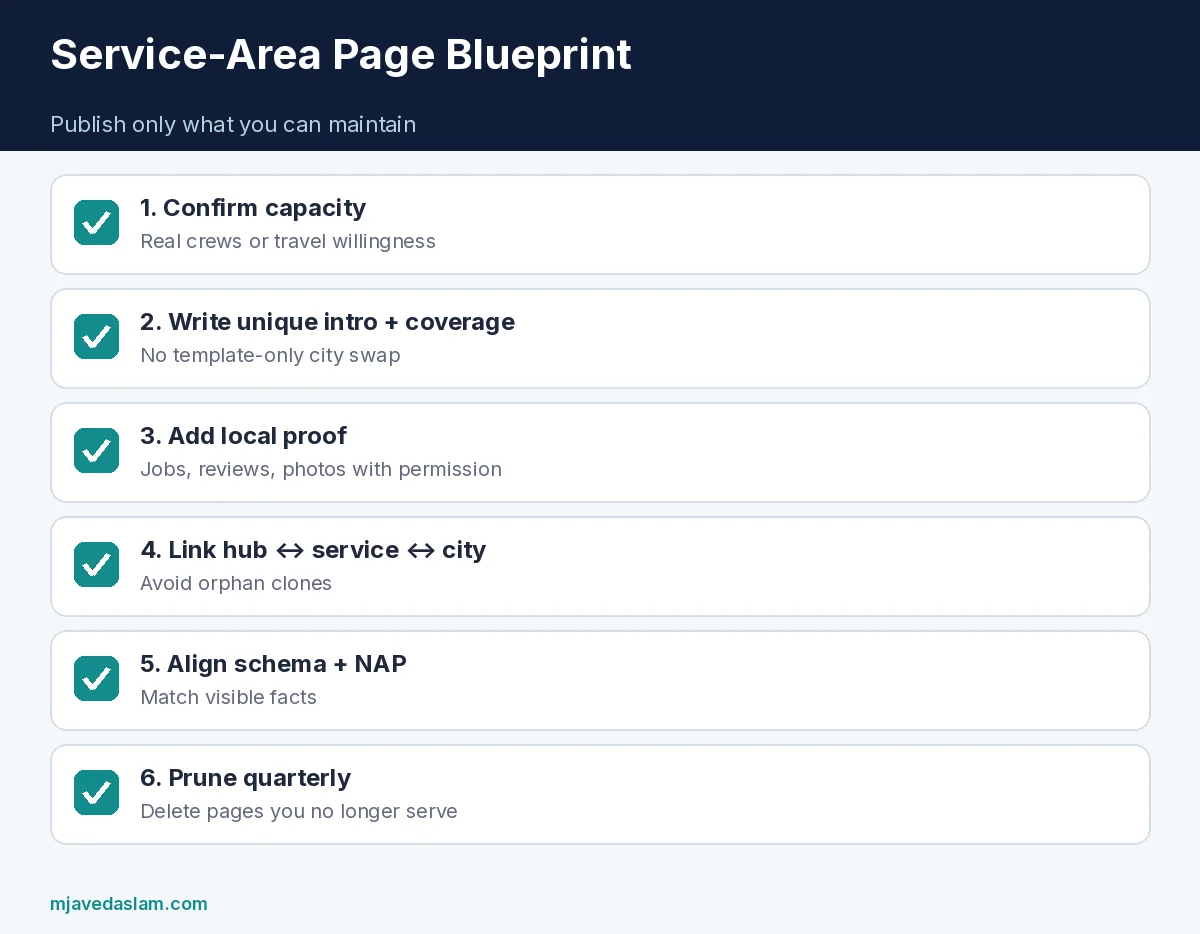
Page blueprint that stays unique
- Intro: service + area + who it is for.
- Coverage honesty: neighborhoods/ZIP you prioritize; where you refer out.
- Services offered there: link to deeper service pages rather than cloning entire service copy.
- Local proof: 2–4 project notes or review excerpts with permission; photos.
- Process & response: how scheduling works in that area.
- FAQs: genuinely local questions.
- CTA: call/form; track if ads land here: conversion tracking.
Add structured data that matches visible content — Service / areaServed patterns without duplicate LocalBusiness graphs: schema for local service pages. Map Pack context: how to rank in the Map Pack.
How many city pages should you publish?
As many as you can keep unique and updated — often fewer than marketing wishlists suggest. A landscaper with three strong county pages beats thirty hollow suburb URLs. Vertical playbooks on this site (plumbers, HVAC, dentists, roofers, electricians, auto repair, cleaning, salons, landscapers, lawyers) all repeat the same rule: capacity and proof first.
Prefer this order:
- Core service pages (money offerings).
- Hub “Areas we serve” with clear links.
- Top cities/counties with real differentiation.
- Only then finer neighborhoods if content quality holds.
Internal links and cannibalization
Each URL needs a distinct primary topic. Do not give five city pages the same Yoast focus keyphrase: Yoast focus keyphrase best practices. Link city pages to the matching service page and back to the hub. Use breadcrumbs if enabled: Yoast breadcrumbs.
Canonical tags belong on true duplicates — not as a bandage for thin doorway clones you should delete instead. Google’s canonical documentation is the reference when consolidating.
Ads + organic on the same URLs
Service-area pages make strong ad landing pages when the headline matches the keyword and the proof is local. Keep negatives so you do not pay for cities you refuse: negative keywords. Channel choice: Google Ads vs Meta Ads for local.
Common mistakes
- Fifty pages with identical word counts and swapped H1s.
- Embedding a Maps iframe as the only “unique” element.
- Promising statewide coverage with a two-person crew.
- Orphan pages with no hub or service links.
- Keyword-stuffed titles that mirror spammy GBP names.
- Leaving old addresses in city footers after a move.
Maintenance cadence
- Quarterly: prune pages you no longer serve; update proof photos.
- After GBP service-area edits: mirror the same story on the hub page.
- When reviews mention a city: add a short, honest line (no fabricated quotes).
GBP services list should align with what city pages promise: GBP products and services.
Photograph jobs with permission and note the general area (neighborhood or city) in the filename and caption workflow so writers can place real visuals on the right page later. Stock skylines of the wrong city undermine trust instantly.
If a page never earns impressions in Search Console after a fair indexing window and you cannot make it unique, merge it into the hub with a 301. Hoarding thin URLs helps no one.
Multi-location brands should avoid copying Franchise City A’s page to City B with a logo swap. Shared sections (warranty national policy) can be reused; proof, teams, and directions must be local.
Voice search and “near me” behavior still resolve heavily through Maps and proximity. Your landing pages should support the website path and ad landers — not invent a fantasy that HTML alone overrides distance.
When sales reps promise a suburb you marked out-of-area on the site, update either the sales playbook or the page the same week. Broken promises become reviews; reviews become prominence problems.
Use Search Console to see which city terms already impress on service pages — sometimes a strong service URL plus a paragraph of coverage beats a weak standalone city URL. Expand only when the outline has unique substance.
Finally, keep the hub page boringly clear: a map or list of areas, links to the best city pages, and a single CTA. Fancy animations do not compensate for doorway clones one click away.
Accessibility matters on local pages too: readable contrast, tap-friendly click-to-call, and alt text that includes the topic naturally when an image shows local work. Decorative dividers do not need keyphrase stuffing in alt.
When storms or emergencies shift coverage, update the hub banner and GBP posts the same day. Stale “we serve everyone” claims during a capacity crunch create angry reviews.
Legal and medical advertisers should have compliance review city-page claims the same way they review ads. Local SEO pages are public advertising in most practical senses.
Uptime and hosting matter when storms drive traffic spikes to weather-sensitive service pages. A down site during peak intent wastes both SEO and ads.
Keep a simple ownership field in your CMS: who updates each city page. Orphan pages without an owner quietly rot into doorway lookalikes.
FAQ: local landing page SEO for service areas
01Are city pages still worth it in 2026?
Yes when they are unique and useful. Thin doorway clones are not worth the spam risk.
02How long should a service-area page be?
Long enough to answer coverage, proof, process, and FAQs — quality over a fixed word-count myth. Do not pad.
03Can pages alone rank me in the Map Pack?
No. Map Pack uses relevance, distance, and prominence. Pages help website relevance and trust; distance is geography; GBP accuracy still matters.
04Should every suburb get a URL?
Only if you can differentiate. Otherwise list suburbs on a county/hub page.
05What is doorway abuse?
Google’s spam policies describe pages created to rank for similar queries and funnel users to largely identical content. Avoid that pattern.
06Do I need separate domains per city?
Almost never for a single small business. One domain with clear information architecture is simpler and safer.
Need help pruning doorway debt and rebuilding a clean area hub? Start at local SEO, GBP services, or services.

✳Written by
Javed Aslam
Digital marketer, copywriter and SEO specialist. I help small businesses get found, read and chosen. More about me.