Google Ads vs Meta Ads for local business is usually a “which channel first?” decision: Google Search captures people already looking for your service; Meta (Facebook/Instagram) helps you create demand with creative, audiences, and local reach when the search volume is thin or the offer needs storytelling.
This comparison is for local service and storefront owners choosing a first paid channel. It is not the Search vs Display deep dive inside Google alone, not a remarketing setup guide, not a cost-only primer, and not the call-ads sunset migration note.
Ads help: Google Ads services.
Google Ads vs Meta Ads for local business — quick answer
- If customers type what you sell (“emergency plumber near me,” “roof repair [city]”), start with Google Ads Search campaigns + location targeting + conversion tracking.
- If the offer needs visual proof, appointments for non-urgent services, or you must manufacture awareness in a radius, start with Meta Ads using local/store-aware targeting and a clear offer creative.
- Many locals eventually use both: Search for high intent; Meta for remarketing and seasonal pushes — but one channel done well beats two starved accounts.
- Budget for learning: track calls/forms properly before judging either platform.
- Do not invent ROAS averages from blogs; build your own baseline over a few weeks of clean data.
Google documents Search Network behavior, location targeting, and Search campaign setup. Meta documents audience targeting, Instagram/Facebook ad surfaces, and store/location targeting options. Product UIs change — verify labels in Ads Manager and Google Ads.
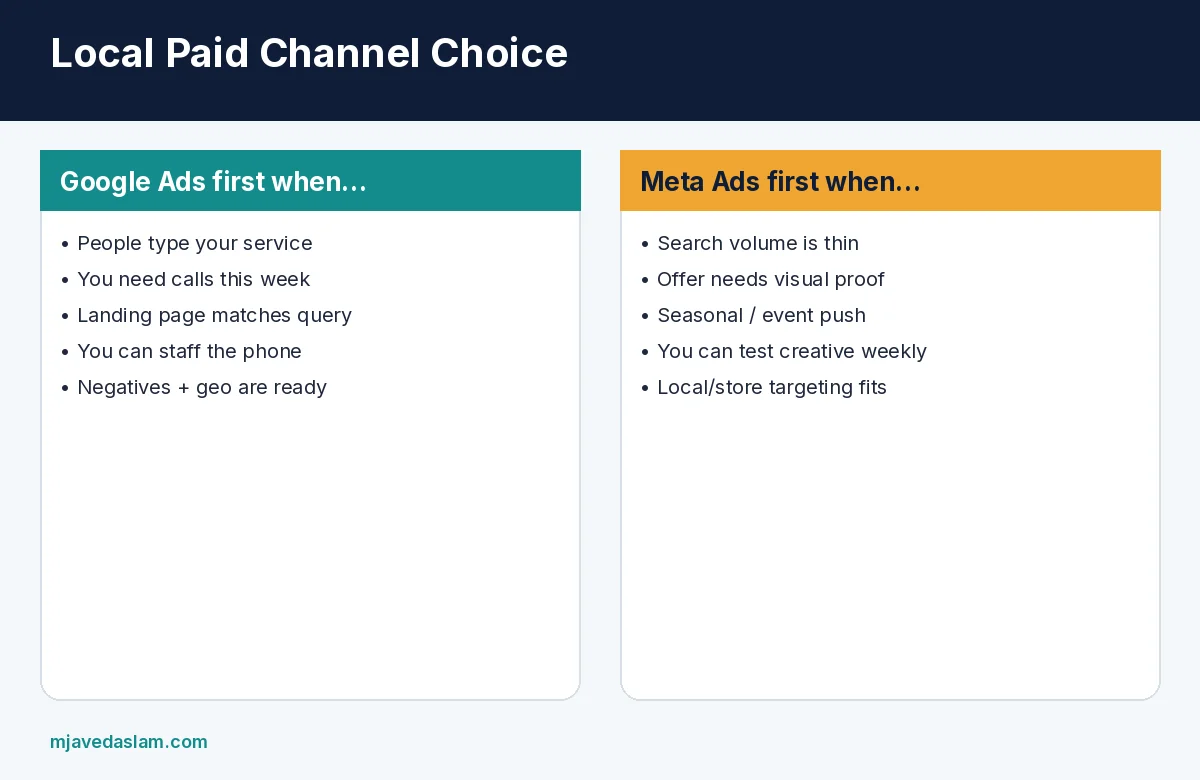
Intent vs interruption (the real difference)
Google Search shows ads when someone queries. That intent is why local plumbers, lawyers, and HVAC firms often start here. Quality Score, match types, and negatives matter: Quality Score, match types, negatives.
Meta Ads interrupt feeds and stories with creative. Targeting can use demographics, interests, custom audiences, and location (including store-set tools Meta documents for businesses with locations). You win with creative clarity and offer, not keyword lists.
Inside Google, Search vs Display is a separate choice: Search vs Display. Display/YouTube can look “Meta-like” but still sit in the Google stack with different buying mechanics.
When Google Ads should go first
- High commercial intent queries exist in your city.
- You can answer the phone or form during business hours.
- You have a landing page that matches the query (service + area honesty).
- You need calls this week more than brand fans next month.
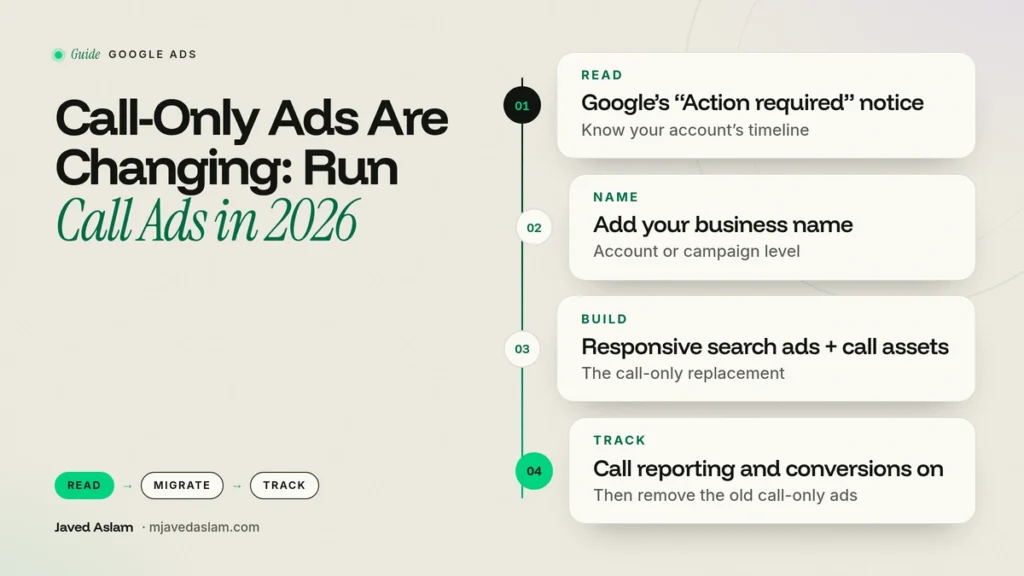
Use location targeting carefully (presence vs interest options as Google labels them in the UI). Enable call assets when calls matter: see the call-ads 2026 notes on this site. Cost context without fake averages: Google Ads cost for small business. Conversion tracking on WordPress: conversion tracking.
When Meta Ads should go first
- Search volume is tiny or dominated by national brands you cannot outbid yet.
- The sale needs photos/video (salon transformations, landscaping before/after, restaurant openings).
- You have a time-bound offer (seasonal, event, grand opening).
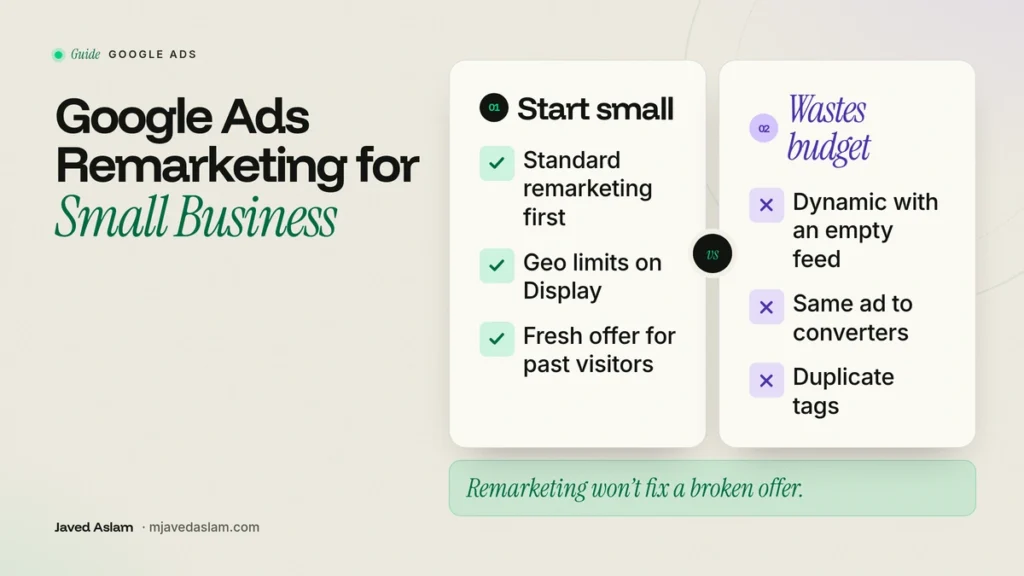
- You can retarget site visitors later — Meta and Google both support remarketing-style audiences when tags are installed: Google Ads remarketing.
Follow Meta’s help on audience targeting and store location targeting if you have physical locations. Keep creative honest — no fake scarcity.
Side-by-side decision table (qualitative)
- Demand: Google captures; Meta often creates.
- Creative load: Google RSA text + assets; Meta needs ongoing images/video.
- Targeting: keywords + geo vs audiences + geo/creative.
- Speed to first lead: often faster on Search when intent exists; Meta needs creative testing time.
- Ops skill: Search needs keyword hygiene; Meta needs creative iteration.
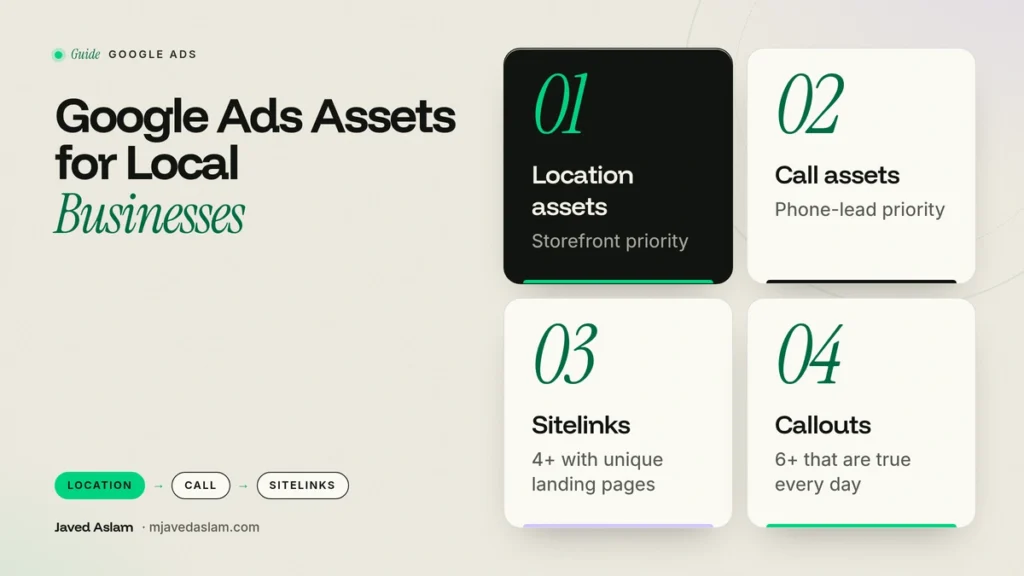
Assets on Google Search campaigns: Google Ads assets for local business.
Budget sequencing for one small team
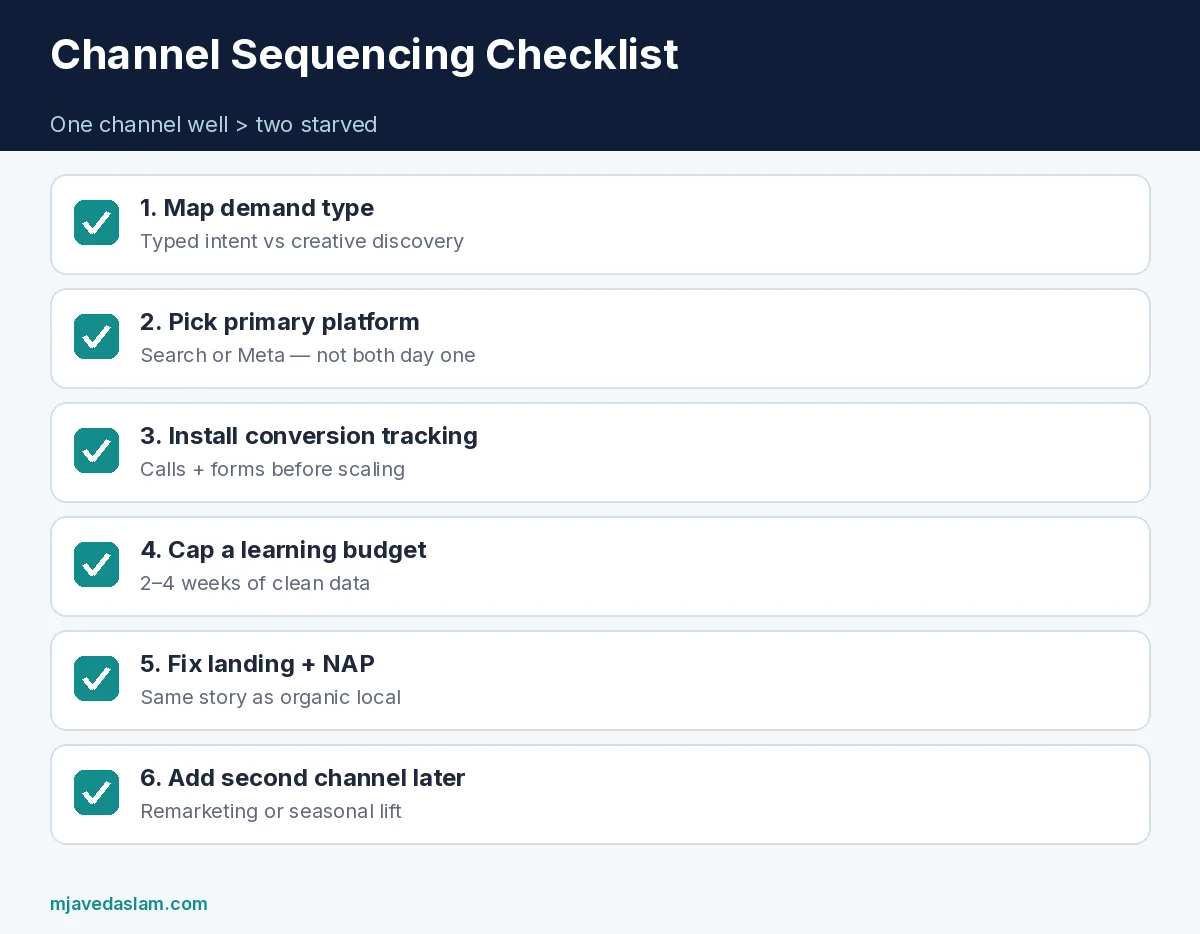
- Pick the primary channel from the lists above.
- Install conversion tracking (calls + forms) before scaling.
- Run 2–4 weeks with a fixed daily cap you can afford to learn with.
- Only then add the second channel for remarketing or seasonal lift.
- Keep NAP and landing pages consistent so ads do not send people to conflicting addresses: see the NAP checklist in this batch.
Local SEO still compounds under paid: local SEO and GBP: Google Business Profile services.
Common mistakes
- Splitting $20/day across four campaigns on two platforms.
- Judging Meta on day two of a cold creative test.
- Running Google Search without negatives or call tracking.
- Sending both platforms to a homepage with no offer.
- Copying national ROAS screenshots as your forecast.
Seasonality flips the recommendation temporarily: a snow-removal company may lean Search hard in the first storm week, then use Meta between storms to stay top-of-mind with creative of cleared driveways. Plan creative before the weather hits.
Compliance still applies on both platforms — restricted categories, local legal advertising rules, and honest claims. A winning CTR on a non-compliant ad is not a win.
Offline conversion imports (qualified booked jobs) beat optimizing to raw form fills when your sales cycle is consultative. Both Google and Meta support more advanced measurement when you are ready; start with accurate call and form tracking first.
Creative fatigue hits Meta faster than keyword ads. Schedule a biweekly creative refresh even if budgets are small: new photo, new headline, same offer. On Google, refresh RSA assets and sitelinks when offers change.
If your margin cannot support competitive Search CPCs in the core city, try surrounding geos, longer-tail keywords, or Meta prospecting with a strong offer — then retarget engagers. Do not “hope” a $5/day Search campaign beats incumbents spending far more.
Team skills matter: a owner who writes clear offers may excel on Meta; a technician-owner who knows every slang search term may excel on Google. Match the channel to the skill you can actually operate weekly.
Revisit the split quarterly using cost per qualified lead, not vanity CPM or impression charts. Kill the loser channel’s waste; reinvest in the winner; keep organic GBP work running either way.
Landing page speed and mobile call buttons affect both platforms. A beautiful Meta creative that lands on a slow homepage wastes spend the same way a perfect RSA does.
Shared budgets across Search and Meta without separate goals create reporting fog. Keep campaigns tagged in your CRM or sheet by channel so you know which conversation started where.
If you outsource, demand weekly creative or keyword notes — not only vanity dashboards. The channel only works if someone is accountable for the next test.
Store visits and call reporting differ by platform and region. Use the conversions you can verify in the real world — booked jobs — as the north star when the UI offers multiple optimization goals.
Test one variable at a time: new creative on Meta, or new match-type package on Google, not both on the same day with the same budget change.
Document your decision in one paragraph for future-you: why this channel first, what success metric, and when you will revisit. That note prevents panic pivots after a single slow week.
FAQ: Google Ads vs Meta Ads for local business
01Which is cheaper for local leads?
It depends on niche CPC/CPM, competition, and creative. There is no honest universal winner — measure cost per qualified lead in your account.
02Can I run only Meta and skip Google?
Yes if your demand is creative-led and search is weak. Revisit Search when queries clearly map to your services.
03Should restaurants prefer Meta?
Often Meta/Instagram creative performs well for discovery; still consider Search for “near me” and high-intent menu queries. Test with tracking.
04Is Google Display the same as Meta?
No. Both can prospect visually, but buying, audiences, and placements differ. See Search vs Display on this site for the Google side.
05Do I need a big creative team for Meta?
You need a steady pipeline of honest photos/short video. Many locals start with phone footage and clear offers — polish later.
06What about organic GBP and SEO?
Paid does not replace organic Map Pack work. Run both tracks when budget allows.
Want a channel plan tied to your service area? Start at Ads services or services.

✳Written by
Javed Aslam
Digital marketer, copywriter and SEO specialist. I help small businesses get found, read and chosen. More about me.