

If you need local SEO for plumbers that actually produces phone calls, start here: verify and complete your Google Business Profile, match categories and services to the jobs you want, earn and reply to reviews, then publish clear service pages for the work and towns you cover. Google’s own local ranking guidance boils down to relevance, distance and prominence — not a secret hack.
Homeowners searching “plumber near me,” “emergency plumber” or “water heater repair [city]” usually see a map pack of three businesses plus organic results. Your goal is to show up in that pack (and on your own site) with accurate info, strong proof and pages that answer the search. Below is the checklist I use with plumbing companies — no ranking promises, just the work that compounds.
I’ll cover Google’s three local factors in plumbing language, the Business Profile setup that matters most, service-page structure, reviews, NAP consistency and a weekly routine you can run in under an hour.
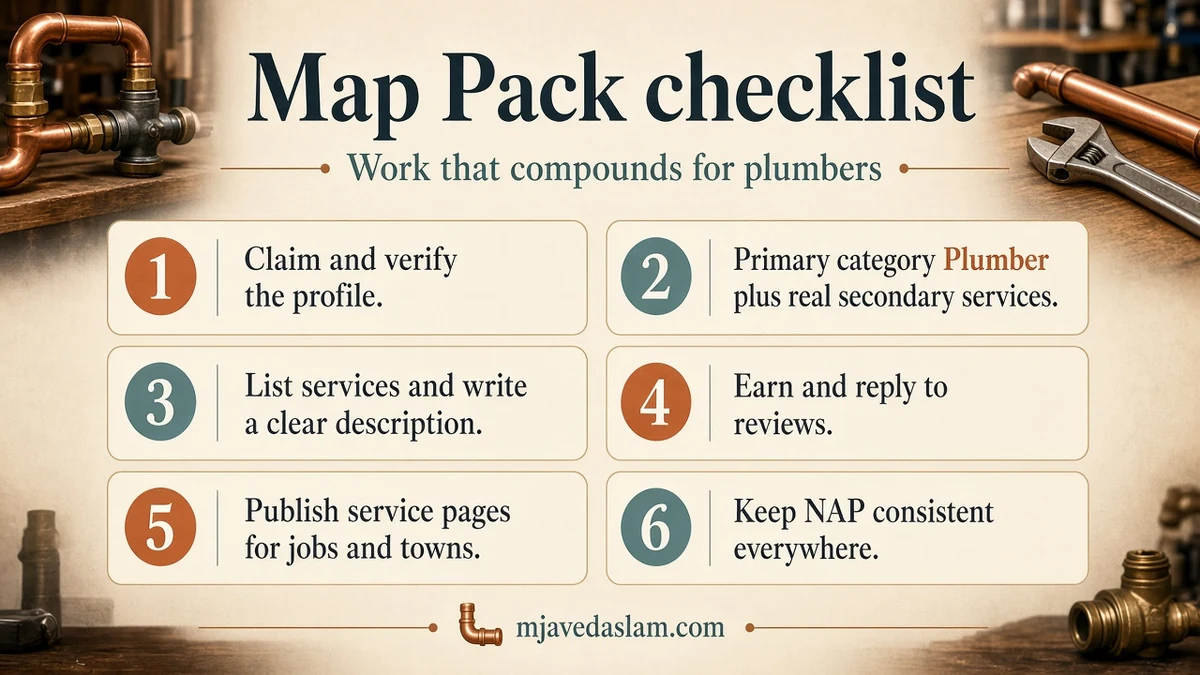
Local SEO for plumbers: the Map Pack checklist
Use this as your operating list. Tick each item once, then revisit monthly.
- Ownership: Claim and verify the profile that matches your real business name. If you haven’t claimed it yet, start with how to claim a Google Business Profile. Video verification tips live in this video verification guide.
- Business type: Storefront with customers walking in, service-area only (you go to them), or hybrid. Hide the street address only when Google’s rules for service-area businesses apply — details in my service-area Business Profile guide.
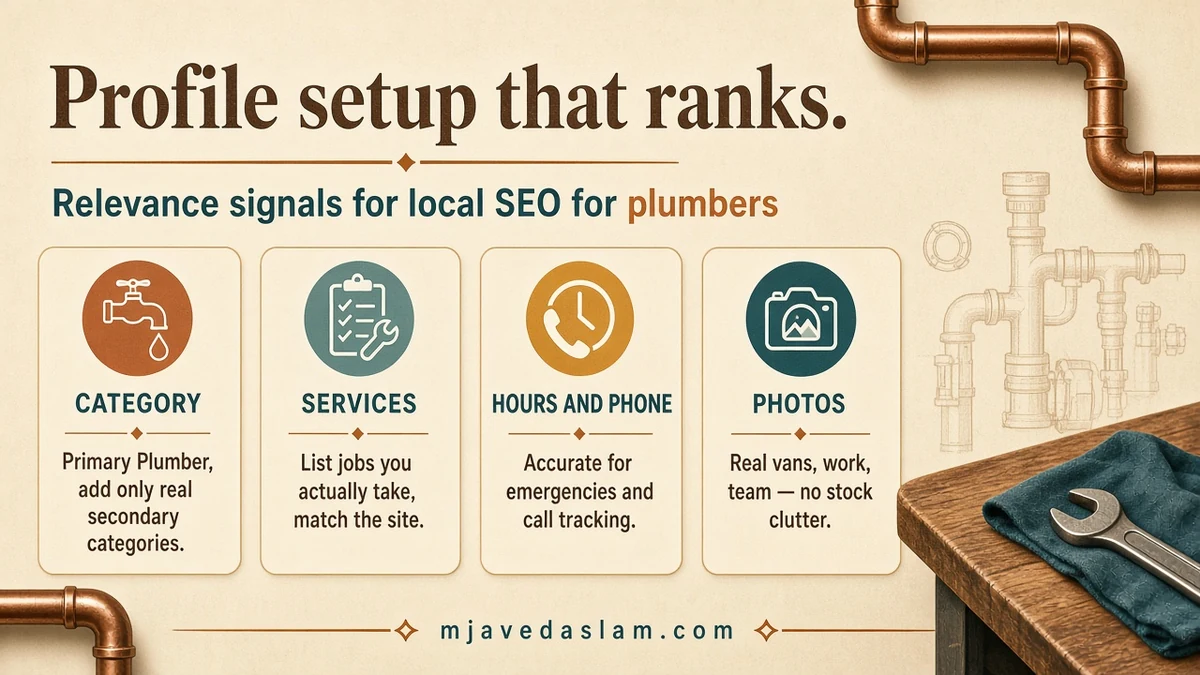
- Primary category: Usually “Plumber.” Add secondary categories that match real services (Water heater repair service, Drain cleaning service, Septic system service) — only if you actually offer them.
- Services + description: List the jobs you want calls for. Write a plain-English description with towns you serve. Skip keyword stuffing.
- Hours, phone, website: Match the number on your vans, invoices and site. Update holiday hours before the holiday.
- Photos: Trucks with branding, before/after jobs (with permission), team in uniform, equipment — no stock-only gallery.
- Reviews: Ask after good jobs, reply to every review, never pay for reviews. A free QR path is in how to create a Google review QR code.
- Website pages: One clear page per major service (and city pages only when you truly serve that area with unique content).
- NAP consistency: Same name, address, phone across the site, profile and major directories.
- Tracking: Dedicated call tracking or at least UTM links so you know Maps-driven calls from other channels.
How Google ranks local results (in plumbing terms)
Google states that local results are mainly based on relevance, distance and prominence (Google’s Help article also refers to this as popularity). You can’t buy a higher Map Pack spot. You can improve how well you match each factor.
Relevance
Does your profile match “emergency plumber,” “tankless water heater install” or “clogged drain”? Categories, services, description, posts and on-site pages all help Google understand what you do. If you only fix residential drains but your profile lists every plumbing keyword imaginable, you confuse the system and the customer.
Distance
How far you are from the searcher (or the place named in the query). You can’t fake this. You can set service areas honestly, keep the correct address type and avoid claiming towns you never drive to. Stretching your service area across half a state usually hurts trust more than it helps.
Prominence
How well-known you appear online: reviews (count and quality), links and mentions from other sites, directory consistency and broader web presence. More helpful reviews and a site people actually cite tend to support prominence. Fake reviews and spammy directories work against you over time.
Google’s tips to improve local ranking are the source of truth here — verify, keep info complete, respond to reviews, add photos. Treat third-party “ranking factor” lists as opinion unless they point back to Google.
Set up the Google Business Profile like a plumbing company
Open Google Business Profile Manager (business.google.com) on a computer when you can. Labels move occasionally; if a button name differs slightly, search Google’s Help for the current path.
- Name: Legal or commonly used business name. Don’t bolt “Best Plumber City Emergency 24/7” onto the name field — Google’s guidelines forbid keyword stuffing in the name.
- Categories: Primary = Plumber. Secondaries only for services you deliver regularly.
- Services: Add the jobs that match search demand you can fulfill: burst pipe repair, water heater replacement, hydro jetting, slab leak detection, fixture install. Price ranges are optional; honesty beats vague “call for quote” everywhere.
- Description: Who you serve (residential, light commercial), where you go, what you’re known for, licensing note if relevant. Keep it readable.
- Attributes: Women-led, veteran-owned, wheelchair accessible office — only if true.
- Messaging / booking: Turn on chat or booking only if someone answers during stated hours.
If you’re primarily mobile, read Google’s service-area rules carefully and don’t publish a fake storefront. For deeper help beyond DIY, my local SEO services page outlines how I work with home-service businesses.
Website pages that support Maps (and win the click)
The Map Pack gets attention; your website closes the call. Plumbers don’t need a 40-page encyclopedia. They need a few strong pages:
- Homepage: Who you are, primary services, service area, phone above the fold, proof (license, insured, years in market only if accurate — don’t invent numbers).
- Service pages: Separate pages for high-intent jobs (e.g., water heater repair, drain cleaning, emergency plumbing). Each page should explain symptoms, process, what to expect on the visit and a clear call button.
- Area pages (careful): Only write a city page when you truly serve that city and can add unique details (neighborhoods, common housing stock issues, response notes). Thin city stubs with the same paragraph swapped for a town name are not useful and can dilute your site.
- About / contact: Real address policy matching your Business Profile type, map embed if you have a public location, click-to-call.
Use plain titles homeowners type: “Emergency Plumber in [City],” not “Synergistic Pipe Solutions Hub.” Internal links from the homepage to services, and from services back to contact, help both people and search engines. If you’re also thinking about AI answers in Search, the habits in how to show up in AI Overviews overlap: clear entities, helpful pages, accurate business info.
Reviews that turn into booked jobs
Google notes that reviews and ratings can support prominence and that responding shows you value feedback. For plumbers, the practical system is simple:
- Ask when the customer is happiest — after the leak is fixed and the floor is dry.
- Make the ask one tap: review link or QR from your Business Profile (official method only).
- Reply to every review. Thank specifics on positives. On negatives, stay calm, take details offline, never argue in public.
- Never offer discounts, gifts or entry into a giveaway for a Google review — that violates Google’s review policies.
Photo reviews of completed work (with permission) help future customers picture the job. Don’t coach people to use exact keyword phrases; authentic language ranks better with humans and avoids looking manipulated.
NAP, citations and the boring consistency work
Name, address and phone should match across your website footer, Business Profile, invoices and major listings (Apple Business Connect, Bing Places, Facebook, industry directories you already use). Fix duplicates instead of creating a second profile “for SEO.”
You do not need hundreds of low-quality citations. Prefer accuracy on a smaller set over spam submissions. When you move or change numbers, update the profile and main listings the same week.
A weekly local SEO routine for a plumbing shop
Thirty to sixty minutes, once a week, beats a yearly panic rewrite:
- Check Business Profile insights: calls, direction requests, website clicks — note which services got attention.
- Reply to new reviews within a day or two.
- Add 2–4 fresh photos from recent jobs (permission cleared).
- Post one short Business Profile update (seasonal tip, hours change, service highlight) if you have something real to say.
- Scan Search Console or analytics for landing pages that get impressions but few calls — tighten the headline and phone CTA.
- Once a month, audit NAP on your top five listings and confirm holiday hours.
That’s local SEO for plumbers without the fluff: complete profile, honest services, useful pages, steady reviews, clean NAP. Do those before you buy more ads or chase every new “Maps trick” video.
If you want a second set of eyes on your profile and service pages, start at local SEO for small businesses or the Google Business Profile help page on this site — I’m happy to help you prioritize what to fix first.
FAQ: Local SEO for plumbers
How do plumbers rank on Google Maps?
Google says local results are mainly based on relevance, distance and prominence. For plumbers that means a complete, verified Business Profile that matches the query, a realistic service area or address, and prominence signals such as reviews and web mentions. There is no paid upgrade for a higher organic Map Pack position.
What is the best Google Business Profile category for a plumber?
Most plumbing companies should set the primary category to Plumber, then add secondary categories only for services they actually offer. Wrong or stuffed categories confuse customers and weaken relevance.
Do plumbers need a website for local SEO?
A Business Profile can generate calls on its own, but a clear website with service pages, click-to-call and matching NAP helps prominence and converts Map Pack clicks. Thin or missing sites leave money on the table when homeowners compare options.
Should plumbers hide their address on Google?
Only if you operate as a service-area business under Google’s rules and customers don’t visit your location. Hiding an address when you have a public shop, or inventing a storefront you don’t have, can cause suspension risk. Follow Google’s service-area guidance.
How important are Google reviews for plumbing companies?
Google lists reviews among the signals that relate to prominence and encourages owners to respond. Reviews also persuade homeowners choosing between three Map Pack options. Focus on legitimate asks after good jobs — not incentives or fake reviews.
Is local SEO different from Google Ads for plumbers?
Yes. Local SEO improves organic Maps and Search visibility over time. Google Ads can put you at the top of Search quickly for a cost per click. Many shops use both: Ads for emergency terms while the profile and site improve. Negatives matter on Ads — see my Google Ads negative keywords list for small business if you run Search campaigns.